
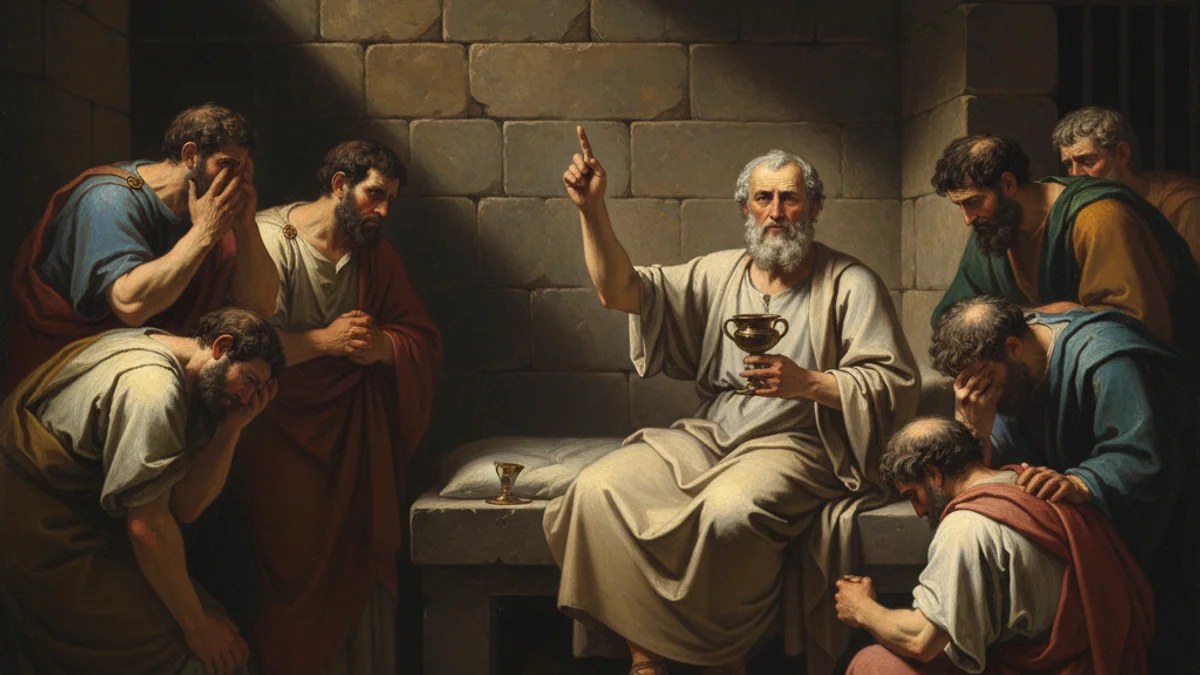
In the year 399 BC, the city of Athens witnessed the final hours of its most provocative thinker. Socrates, found guilty of impiety and corrupting the youth, sat in his prison cell awaiting the execution of his sentence. Despite his friends' desperate pleas and a well-organized plan for his escape, the philosopher remained resolute. He argued that to flee would be to violate the social contract he had lived by his entire life. As his disciples wept, Socrates spent his last afternoon engaging in a calm, profound dialogue about the immortality of the soul and the nature of the afterlife. When the jailer arrived with the cup of crushed hemlock, Socrates took it with a steady hand. He offered a small prayer, drank the poison without hesitation, and walked until his legs grew heavy. Laying down, he reminded his friend Crito of a small debt before the coldness reached his heart, meeting his end with the same unwavering logic and composure that had defined his life.
Integrity consists of remaining faithful to one's principles and the rule of law, even when faced with the ultimate sacrifice.
Advertisement
Questions about this story
What is the moral of The Death of Socrates?
The story teaches that a person of integrity must stand by their convictions and respect the law, even if it leads to their own demise. It emphasizes that the soul and one's principles are more important than physical survival.
Why was Socrates sentenced to death?
He was officially charged with impiety against the gods of Athens and with corrupting the minds of the city's youth through his questioning methods. These charges were largely politically motivated by citizens who found his constant questioning disruptive.
What poison did Socrates drink?
Socrates was executed by drinking a potion made from the poisonous hemlock plant. This was a standard method of execution for high-status citizens in ancient Athens.
Why did Socrates refuse to escape from prison?
He believed that because he had lived in Athens and benefited from its laws his whole life, he had an implied contract to obey those laws. To escape would be to act unjustly and undermine the very society he respected.
Advertisement

