
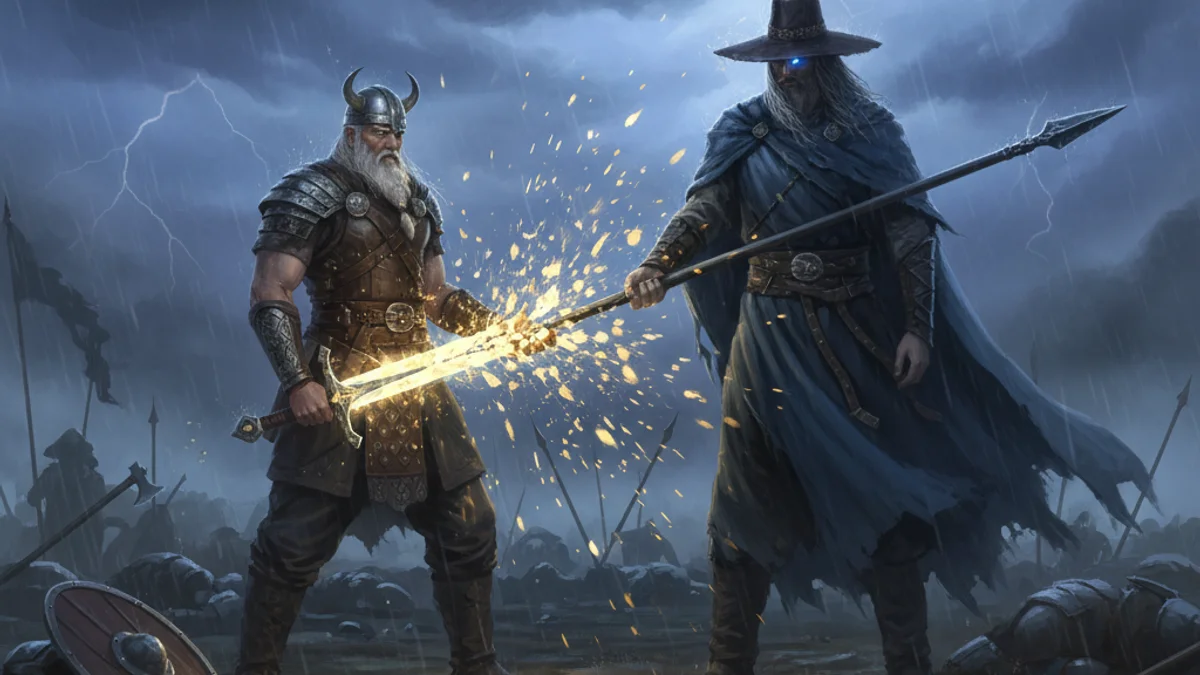
Sigmund, the legendary king of the Volsungs, had reigned long and fought many battles with the divine sword Gram, which he alone had pulled from the tree Barnstokkr. In his final conflict, he faced the overwhelming army of King Lyngvi. Despite his age, Sigmund fought with unmatched ferocity, his blade carving through shields and mail alike. However, the tide turned when a tall, one-eyed man dressed in a blue cloak and a wide-brimmed hat appeared on the battlefield. The stranger raised a heavy spear, and when Sigmund struck at it, the mighty sword Gram shattered into pieces. Recognizing the intervention of Odin, Sigmund realized his time had come. He fell, mortally wounded by his enemies. As he lay dying, he refused medical aid, telling his wife Hjordis that Odin no longer wished him to win. He entrusted her with the shards of his sword, prophesying that they would be reforged for their unborn son, Sigurd, who would become the greatest hero of their lineage.
Even the mightiest heroes must accept their mortality and the will of fate when their time has passed.
Questions about this story
What is the moral of The Death of Sigmund?
The moral focuses on the inevitability of fate and the importance of legacy. It teaches that even greatness must eventually give way to the next generation according to the will of the divine.
Who killed Sigmund in Norse mythology?
Sigmund was mortally wounded by the army of King Lyngvi, but his death was truly orchestrated by Odin, who shattered Sigmund's sword with his spear Gungnir.
What happened to Sigmund's sword, Gram?
The sword Gram was shattered by Odin's spear during Sigmund's final battle. The broken shards were later kept by his wife, Hjordis, and eventually reforged for their son, Sigurd.
Why did Odin break Sigmund's sword?
Odin decided that Sigmund's time on earth was over and he was needed in Valhalla. By breaking the sword, Odin withdrew his protection and allowed the hero to fall in battle.
Advertisement

Good night.
