
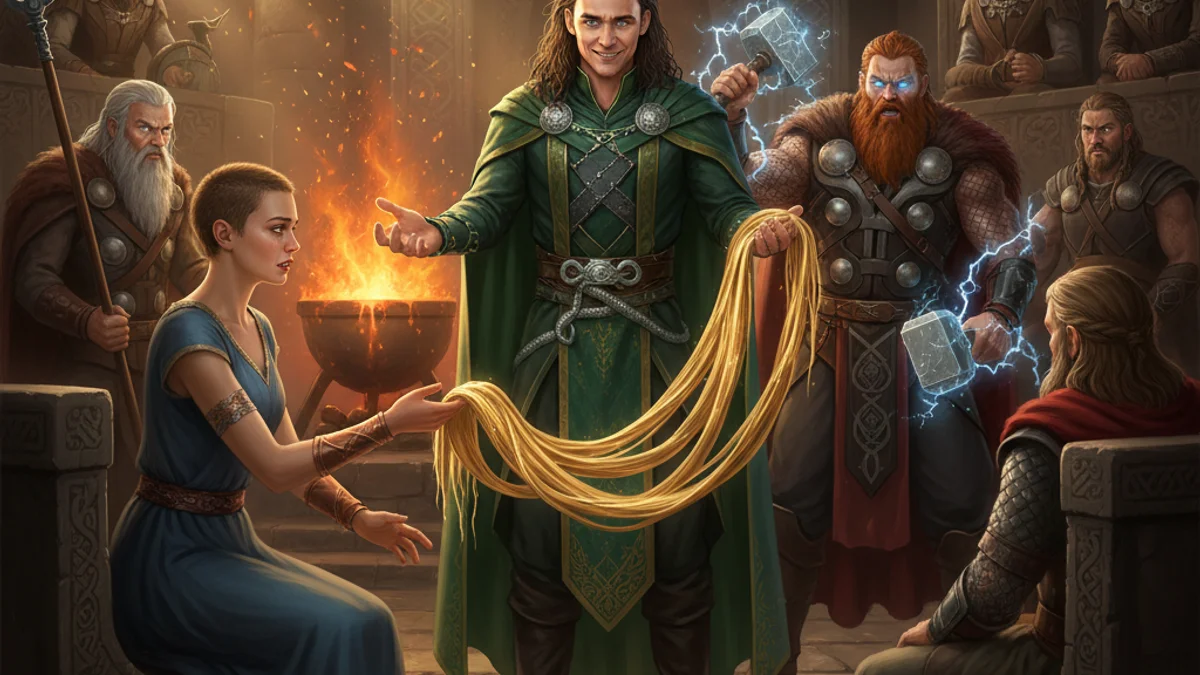
One night, the trickster Loki snuck into the chambers of Sif, the wife of Thor, and sheared off her magnificent golden hair as a cruel prank. When Thor discovered the deed, his rage shook the foundations of Asgard. He seized Loki, threatening to crush every bone in his body unless he found a way to replace the hair. Terrified, Loki descended to Svartalfheim, the realm of the dwarves. He persuaded the Sons of Ivaldi to forge a headpiece of spun gold that would grow from Sif’s scalp like natural hair. Not content to stop there, Loki goaded other dwarf smiths, Brokkr and Eitri, into a competition, wagering his own head that they couldn't produce finer treasures. Despite Loki’s attempts to sabotage their work by transforming into a fly, the dwarves produced Gungnir the spear, Skidbladnir the ship, and the mighty hammer Mjolnir. Loki returned to Asgard with the treasures, and while he narrowly kept his head through a clever technicality, his spiteful prank ultimately provided the Aesir with their greatest weapons of power.
Reckless mischief can cause deep harm, but taking accountability and seeking restoration can lead to unexpected and lasting greatness.
Questions about this story
What is the moral of Loki and Sif's Hair?
The story teaches that actions have consequences and that one must make amends for their mistakes. It also shows how conflict and challenges can lead to the creation of something legendary and beneficial for the community.
Why did Loki cut Sif's hair?
Loki cut Sif's hair out of pure mischief and his impulsive desire to cause chaos. He targeted Sif because her golden hair was her most prized feature and its loss would deeply upset both her and Thor.
What treasures were created because of Loki's wager?
The competition resulted in six legendary items: Sif's golden hair, the spear Gungnir, the ship Skidbladnir, the golden boar Gullinbursti, the multiplying ring Draupnir, and the hammer Mjolnir.
How did Thor react to Loki's prank?
Thor was instantly furious and physically threatened Loki, promising to break his bones. This reaction forced Loki to seek a supernatural solution from the master craftsmen of the dwarven realms.
Advertisement
Good night.
