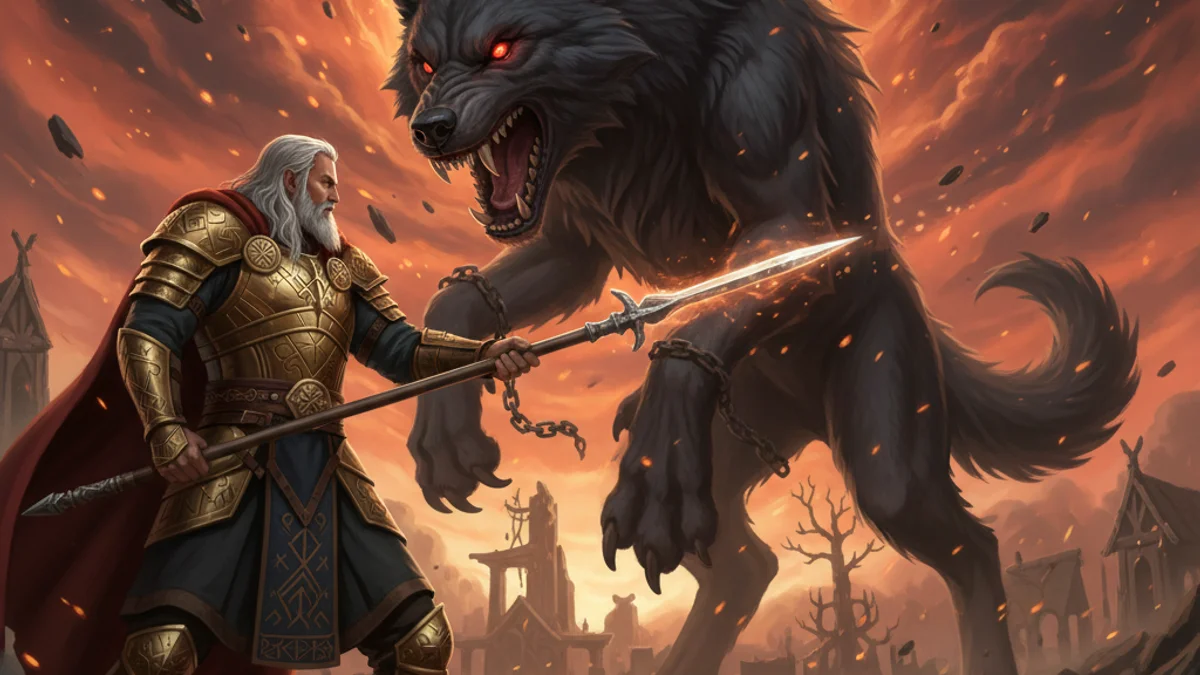
As the foundations of the Nine Realms trembled, the horn of Heimdall sounded the arrival of Ragnarok. Odin, the All-Father, knew his long-foretold destiny had arrived. He donned his golden helmet and led the Einherjar from the gates of Valhalla toward the plain of Vigrid. Across the battlefield, the earth cracked under the weight of the monstrous wolf Fenrir, whose lower jaw touched the ground while his upper reached the heavens. With the spear Gungnir in hand, Odin charged, representing the wisdom and order of the world against the encroaching chaos. The battle was fierce, but the prophecy was absolute. Fenrir opened his massive maw and swallowed the All-Father whole, ending the reign of the king of the Aesir. However, Odin's death was immediately avenged by his son Vidar, who stepped on the wolf's jaw and tore the beast asunder, ensuring that while the old world died with Odin, the possibility of a new one remained.
Even the highest gods are subject to destiny, teaching us to face the inevitable with courage and honor.
Advertisement
Questions about this story
What is the moral of The Death of Odin?
The story emphasizes that destiny is inescapable and that true greatness is found in meeting one's fate with bravery. It also suggests that every ending contains the seeds of a new beginning through the survival of the next generation.
Who killed Odin during Ragnarok?
Odin was killed and consumed by the giant wolf Fenrir, the son of Loki. This event was a central prophecy of Ragnarok that Odin spent lifetimes trying to prevent or prepare for.
How did Odin's son Vidar avenge him?
Vidar, the silent god, wore a thick boot made from the scraps of all the world's shoemakers. He used this boot to hold down Fenrir's lower jaw and tore the wolf's throat apart with his hands.
Did Odin know he would die at Ragnarok?
Yes, Odin was a seeker of wisdom who sacrificed an eye and hung from Yggdrasil to learn the secrets of the runes. He was fully aware of the prophecy concerning his death at the jaws of Fenrir.
Advertisement
