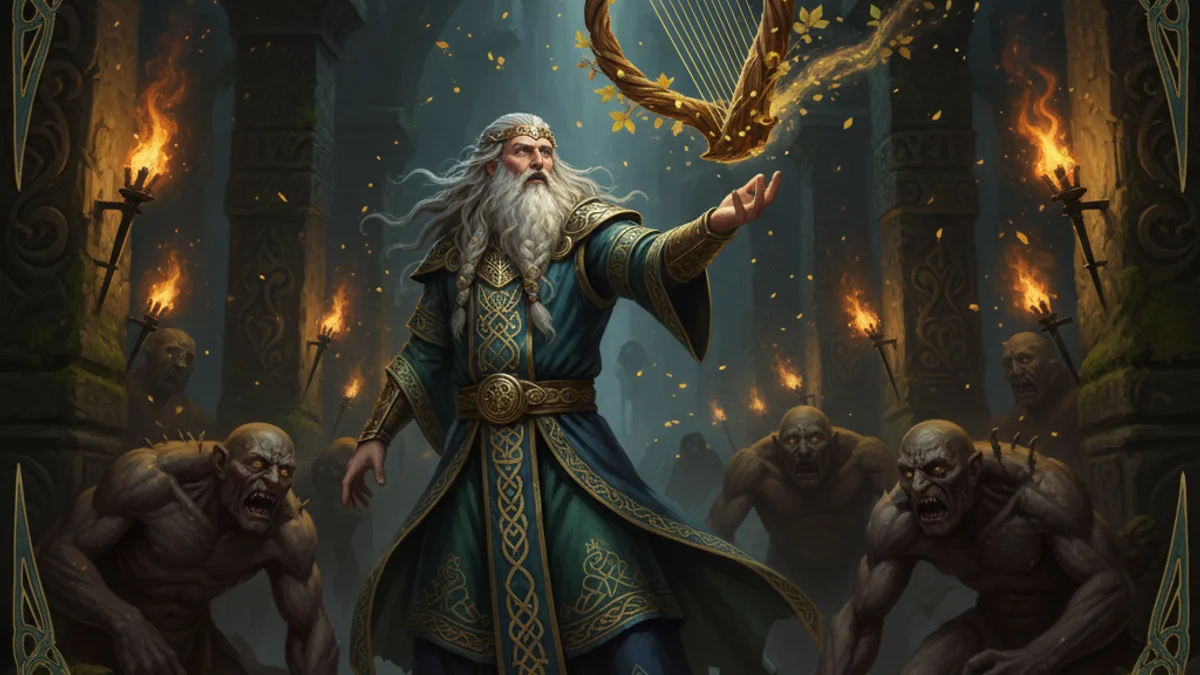
During the great war between the Tuatha Dé Danann and the Fomorians, the magical harp of the Dagda, known as Uaithne, was stolen by the enemy. The Fomorians took the ornate oak instrument to their feast hall, hanging it on a wall as a trophy of war. The Dagda, accompanied by the warriors Lugh and Ogma, tracked the thieves to their camp. Entering the crowded hall, the Dagda called out to his harp. The instrument, which possessed a spirit of its own, leaped from the wall, killing nine Fomorians as it whistled through the air to reach its master's hands. To ensure their escape, the Dagda struck the strings to play the three sacred strains of music. First, he played the Goltrai, the strain of sorrow, making the Fomorian warriors weep with uncontrollable grief. Next, he played the Gentrai, the strain of joy, causing them to break into frantic, helpless laughter. Finally, he played the Suantrai, the strain of slumber, which plunged the entire host into a deep, magical sleep. With their enemies neutralized by the power of song, the Dagda and his companions walked out of the hall unharmed, reclaiming the voice of the seasons.
True power lies not in brute strength or theft, but in the harmony and mastery of one's own creative spirit.
Questions about this story
What is the moral of The Dagda's Harp?
The story teaches that art and music possess a unique power that can overcome physical force and violence. It highlights that true authority comes from the ability to command emotions and nature rather than just through weapons.
What were the three magical melodies the Dagda played?
He played the Goltrai (strain of weeping), the Gentrai (strain of laughter), and the Suantrai (strain of sleeping). These melodies allowed him to control the emotions and physical states of his enemies completely.
Who stole the harp from the Dagda?
The harp was stolen by the Fomorians, the monstrous and chaotic rivals of the Tuatha Dé Danann. They took it after a battle, hoping to strip the Great God of his most musical treasure.
What was the name of the Dagda's harp?
The harp is most commonly known as Uaithne, though it is also referred to as 'Dur dabla' (the oak of two greens). It was a living entity that could only be played by the Dagda himself.
Advertisement
Good night.
