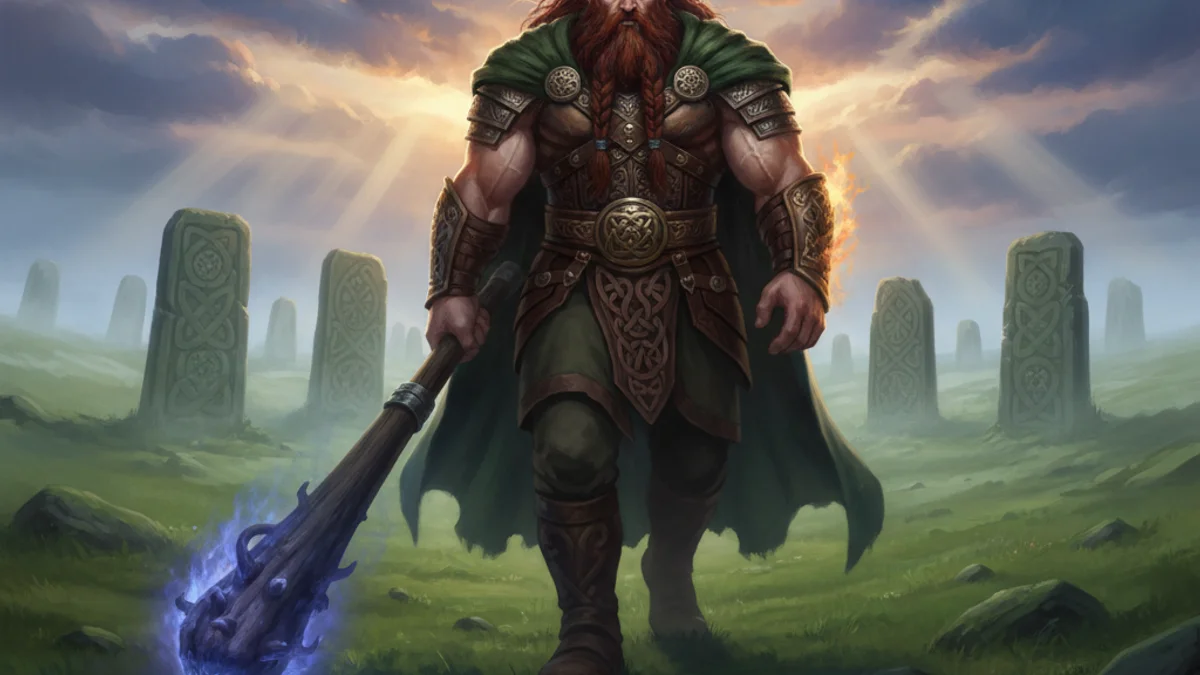
The Dagda, the 'Good God' and leader of the Tuatha Dé Danann, was a figure of immense power and earthiness. Among his three great treasures was the Lorg Mór, a massive, iron-bound club so heavy that it left a deep furrow in the earth wherever it was dragged. This weapon possessed a terrifying and miraculous duality: with one end, he could slay nine men in a single blow, but with the other, he could restore the dead to life with a gentle touch. During the conflicts between the gods and the monstrous Fomorians, the Dagda used his club to maintain the cosmic balance. Even when his enemies sought to humiliate him by forcing him to consume a gargantuan pit of porridge, the Dagda remained a figure of vital strength. He carried the weight of life and death on his shoulders, proving that a true protector must be as capable of healing as they are of destruction. His club was not merely a weapon, but a tool for carving the very boundaries of the Irish landscape.
True power lies in the balance between destruction and restoration, and a leader's greatest strength is the ability to heal.
Questions about this story
What is the moral of The Dagda's Club?
The story teaches that power is dual-natured and should be used responsibly. It highlights that the ability to give life is just as important as the strength to take it in defense of one's people.
What was the name of the Dagda's club?
The club is most commonly referred to as the Lorg Mór, which translates to 'The Great Staff.' It is also sometimes called the Lorg Anfaid, associated with the power of storms.
What were the specific powers of the Dagda's club?
The club had two distinct ends with opposite powers. One end could instantly kill nine enemies at once, while the smooth end could resurrect the dead and heal any wound.
Who was the Dagda in Celtic mythology?
The Dagda was the chief god and father-figure of the Tuatha Dé Danann in Irish myth. His name means 'The Good God,' signifying his mastery over many different skills and crafts.
Advertisement
Good night.
