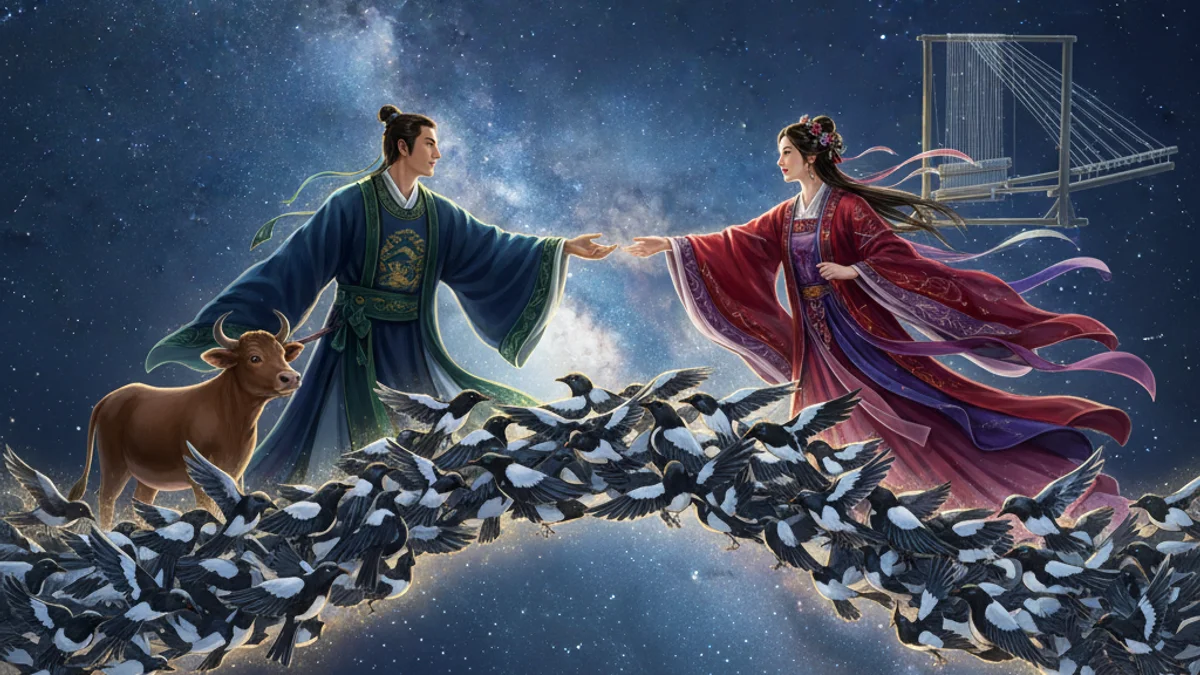
Once, a humble cowherd named Niulang lived a lonely life with only an old ox for company. One day, the ox spoke, revealing it was a fallen deity, and guided Niulang to a magical pond where the seven daughters of the Jade Emperor were bathing. Niulang fell in love with Zhinü, the youngest sister and a celestial weaver. They married in secret and lived happily for years, raising two children. However, when the Queen Mother of the West discovered a goddess had married a mortal, she was furious. She dragged Zhinü back to the heavens. Using a magical hide given to him by his dying ox, Niulang flew into the sky with his children to rescue her. Just as he reached her, the Queen Mother scratched a vast, silver river across the sky with her hairpin—creating the Milky Way. Heartbroken, the lovers stood on opposite banks, destined to be apart. Moved by their devotion, the world's magpies flew up to form a bridge over the river once a year on the seventh day of the seventh lunar month, allowing the lovers a single night of reunion.
True love is an eternal bond that can overcome any obstacle, even the vast expanse of the heavens.
Advertisement
Questions about this story
What is the moral of The Cowherd and Weaver Girl?
The story teaches that true love is resilient and enduring. It suggests that even the most powerful forces cannot completely destroy a bond built on genuine devotion.
Which festival celebrates The Cowherd and Weaver Girl?
The Qixi Festival, often referred to as Chinese Valentine's Day, is celebrated on the seventh day of the seventh lunar month to honor their annual reunion.
Who separated the Cowherd and the Weaver Girl?
The Queen Mother of the West separated them using her golden hairpin to create the Silver River, known as the Milky Way, to keep the mortal and immortal worlds apart.
What stars represent Niulang and Zhinü?
In astronomy, Niulang is represented by the star Altair and Zhinü is represented by the star Vega, which are separated by the Milky Way in the night sky.
Advertisement