
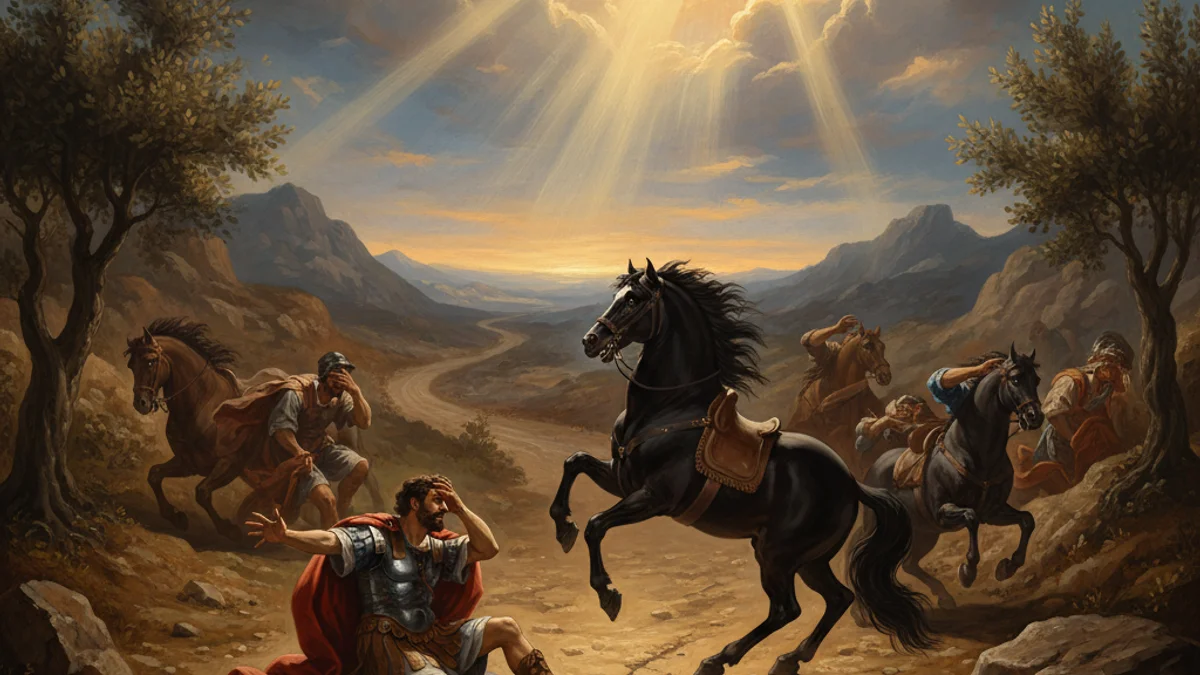
Saul of Tarsus was a man of fierce conviction and a zealous Pharisee who dedicated his life to the destruction of the early Christian movement. Armed with letters of authority, he set out for Damascus to arrest any followers of Jesus he found there. As he neared the city, a sudden light from heaven, brighter than the noonday sun, flashed around him. Falling to the ground, he heard a voice crying out, 'Saul, Saul, why do you persecute me?' Trembling, Saul asked, 'Who are you, Lord?' The voice replied, 'I am Jesus, whom you are persecuting.' Saul rose from the ground, but when he opened his eyes, he could see nothing. For three days he remained blind, neither eating nor drinking. In Damascus, a disciple named Ananias received a vision from God telling him to find Saul. Despite his fear of the notorious persecutor, Ananias obeyed. He laid his hands on Saul, saying that Jesus had sent him so that Saul might see again and be filled with the Holy Spirit. Immediately, something like scales fell from Saul’s eyes, and his sight was restored. He was baptized, took the name Paul, and began at once to preach that Jesus is the Son of God, transforming from the Church’s greatest enemy into its most tireless apostle.
No one is beyond the reach of divine grace, and even the most hardened hearts can be transformed into instruments of peace and faith.
Questions about this story
What is the moral of The Conversion of Saint Paul?
The story teaches that redemption is possible for everyone, regardless of their past. It illustrates that divine grace can transform an enemy into a powerful force for good.
Where did the conversion of Saint Paul take place?
The event occurred on the road to Damascus, a city in modern-day Syria. Saul was traveling there specifically to arrest and persecute early Christians.
Why did Saul change his name to Paul?
Saul was his Hebrew name, while Paul was his Roman name. After his conversion, he used his Roman name more frequently to better connect with the Gentile populations he missionized.
Who was Ananias in the story of Saint Paul?
Ananias was a Christian disciple in Damascus whom God instructed in a vision to heal Saul. His obedience despite his fear was crucial to Paul's physical and spiritual recovery.
Advertisement
Good night.
