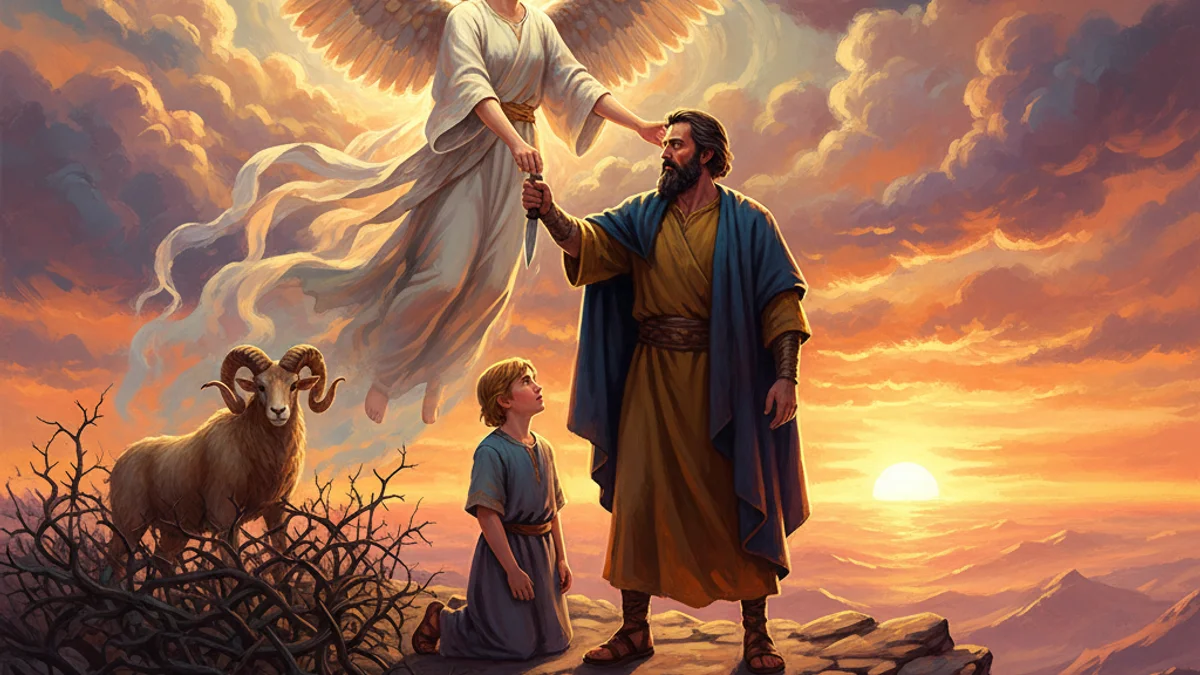
After years of waiting for a son, Abraham was given Isaac, the child of promise. Yet, God sought to test Abraham’s devotion with a harrowing command: 'Take your son, your only son, whom you love—Isaac—and sacrifice him as a burnt offering on the mountain I will show you.' Without hesitation, Abraham set out with Isaac. On the third day, they reached Mount Moriah. As they climbed, Isaac asked, 'Father, the fire and wood are here, but where is the lamb for the offering?' Abraham replied, 'God himself will provide the lamb.' At the summit, Abraham built an altar and bound his son. Just as he raised the knife, an angel called out from heaven, 'Do not lay a hand on the boy!' God recognized Abraham's absolute faith. Looking up, Abraham saw a ram caught in a thicket by its horns and sacrificed it in place of his son. Because of his obedience, God promised to bless Abraham's descendants as numerous as the stars.
True faith is measured by one's willingness to trust and obey God even when faced with the most difficult and inexplicable trials.
Advertisement
Questions about this story
What is the moral of The Binding of Isaac?
The moral focuses on the power of absolute faith and obedience to divine will. It suggests that when one puts God above all else, they are met with mercy and abundance.
Why did God ask Abraham to sacrifice Isaac?
The story depicts this as the ultimate test of Abraham’s loyalty and fear of God. It serves to prove that Abraham was worthy of the covenant and the fatherhood of nations.
What does the word Akedah mean?
The term 'Akedah' is Hebrew for 'binding.' It refers specifically to the act of Abraham tying Isaac to the altar before the intervention of the angel.
What is the significance of the ram in the story?
The ram serves as a substitute sacrifice, representing God's provision. In Jewish tradition, its horn (shofar) is used to remember the event and call for divine mercy.
Advertisement