
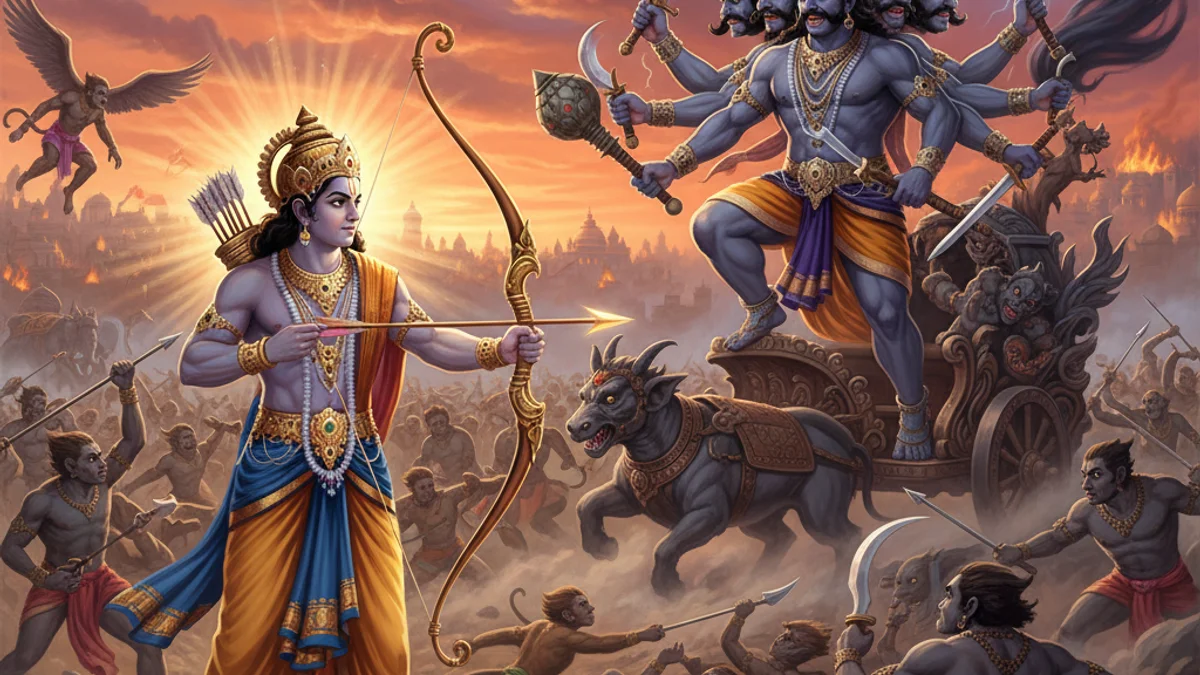
Lord Rama, accompanied by his brother Lakshmana and an army of Vanaras led by Hanuman and Sugriva, stood upon the shores of the great ocean. To rescue Sita from the clutches of the ten-headed demon king Ravana, they constructed the miraculous Ram Setu bridge across the sea. Upon reaching Lanka, a monumental war erupted between the forces of Dharma and Adharma. The battlefield shook as legendary warriors clashed, including the giant Kumbhakarna and the master of illusions, Indrajit. When Lakshmana was mortally wounded, Hanuman exhibited his devotion by carrying the entire Dronagiri mountain to provide the Sanjivani herb. The climax arrived when Rama faced Ravana in a final, divine duel. With the Chariot of Indra and the guidance of the sage Agastya, Rama unleashed the Brahmastra, striking Ravana where he was vulnerable. The fall of the demon king signaled the end of tyranny, the rescue of Sita, and the restoration of cosmic balance.
The ultimate victory of righteousness (Dharma) over ego and evil (Adharma) is inevitable, regardless of how powerful the adversary appears.
Questions about this story
What is the moral of The Battle of Lanka?
The moral is that righteousness and truth will always prevail over ego and evil. It teaches that even the most powerful being will fall if they lack character and follow an unrighteous path.
How did Rama's army cross the sea to Lanka?
They built the Ram Setu, a bridge made of floating stones inscribed with Rama's name. This feat was accomplished by the Vanara army, specifically the engineers Nala and Nila.
Who was the brother of Ravana that joined Rama?
Vibhishana, Ravana's younger brother, joined Rama's side. He chose the path of Dharma after his brother ignored his advice to return Sita and end the conflict peacefully.
How did Hanuman save Lakshmana during the battle?
When Lakshmana was wounded by Indrajit's weapon, Hanuman flew to the Himalayas to find the Sanjivani herb. Unable to identify it, he carried the entire Dronagiri mountain back to the battlefield.
Advertisement
Good night.
