
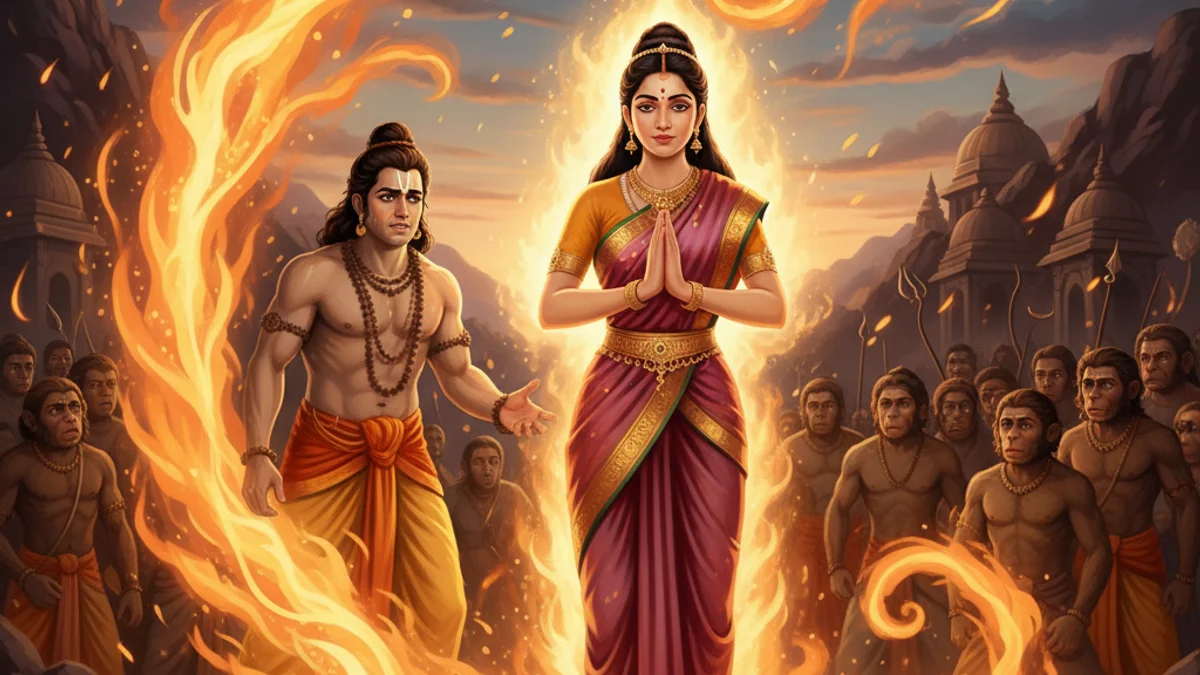
Following the epic battle in Lanka and the defeat of the demon king Ravana, Sita was finally reunited with Lord Rama. However, to the shock of those gathered, Rama spoke words of doubt, questioning Sita's purity after her long captivity in Ravana's palace. He declared that as a king, he could not accept a queen whose character might be questioned by his subjects. Devastated but resolute in her virtue, Sita requested Lakshmana to prepare a funeral pyre. She intended to prove her innocence through the 'Agni Pariksha' or Fire Trial. With a prayer to the gods, she stepped into the roaring flames. To the amazement of the assembly, Agni, the God of Fire, emerged from the blaze holding Sita. Not a hair on her head was singed, and her clothes remained pristine. Agni testified to her absolute purity, and Rama, with tears of relief, accepted her back. He explained that he never doubted her himself, but required this public display to ensure his people would always respect her as their Queen.
True virtue and integrity remain untarnished even in the fiercest of trials.
Questions about this story
What is the moral of Sita's Fire Trial?
The moral is that truth and purity possess their own strength and will eventually be vindicated. It also highlights the difficult balance between personal trust and public duty for a leader.
Why did Rama ask Sita to undergo the fire trial?
Rama acted as a king bound by social dharma; he needed a public proof of Sita's purity to silence any future scandals and ensure her acceptance by the kingdom.
Who is Agni in the Ramayana?
Agni is the Hindu God of Fire who serves as a divine witness in the story. He protects Sita from the heat and testifies to her innocence before Rama and the world.
What happened to Sita after the Agni Pariksha?
After being vindicated by the fire, Sita returned to Ayodhya with Rama, where she was officially crowned as the Queen during Rama's coronation.
Advertisement
Good night.
