
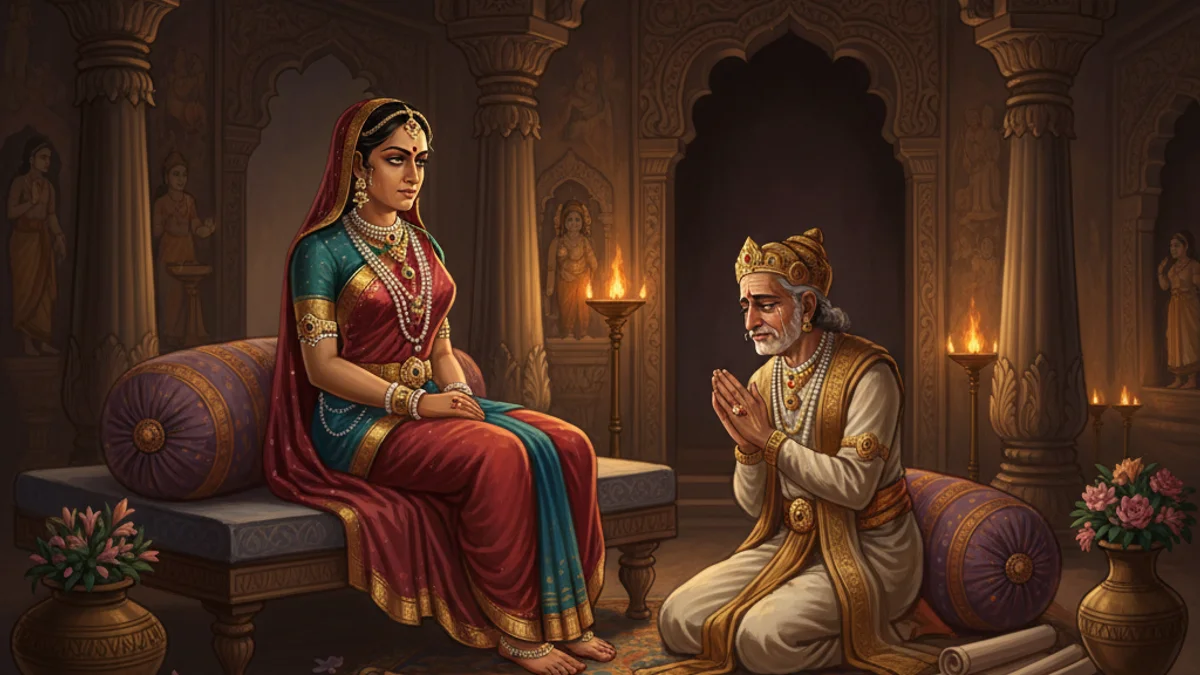
King Dasharatha of Ayodhya intended to crown his beloved eldest son, Rama, as the next king. While the kingdom celebrated, a wicked maidservant named Manthara poisoned Queen Kaikeyi’s mind, convincing her that Rama’s rule would lead to her son Bharata’s ruin and her own misery. Years prior, Kaikeyi had saved the King's life on a battlefield, and in gratitude, he had promised her two boons to be used whenever she wished. Prompted by Manthara, Kaikeyi called upon these forgotten promises. She demanded that Bharata be crowned king and that Rama be exiled to the Dandaka forest for fourteen years. Dasharatha, bound by his dharma and the sanctity of his word, was devastated but unable to refuse. Rama, epitomizing the perfect son, calmly accepted the decree to preserve his father's honor and departed for the forest, leaving Ayodhya in deep mourning.
One must be careful of the counsel they keep and understand that upholding a promise is a sacred duty, even when it brings personal sorrow.
Questions about this story
What is the moral of Kaikeyi's Boons?
The story emphasizes that the company one keeps can cloud judgment, as seen with Manthara’s influence. It also teaches the importance of 'Vachan,' or the sanctity of keeping one's promise regardless of the consequence.
Why did Kaikeyi ask for Rama's exile?
She was manipulated by her maid Manthara into believing that Rama's coronation would result in the ill-treatment of her own son, Bharata. This fear drove her to use her boons to ensure her son's safety and power.
What were the two boons Dasharatha promised Kaikeyi?
The first boon was that her son, Bharata, should be crowned the King of Ayodhya instead of Rama. The second boon was that Rama must be sent into exile in the forest for fourteen years.
How did Manthara influence Kaikeyi's decision?
Manthara used fear-mongering and jealousy to turn Kaikeyi's love for Rama into suspicion. She convinced the queen that once Rama became king, Kaikeyi would lose her status and Bharata would be treated as a slave.
Advertisement
Good night.
