
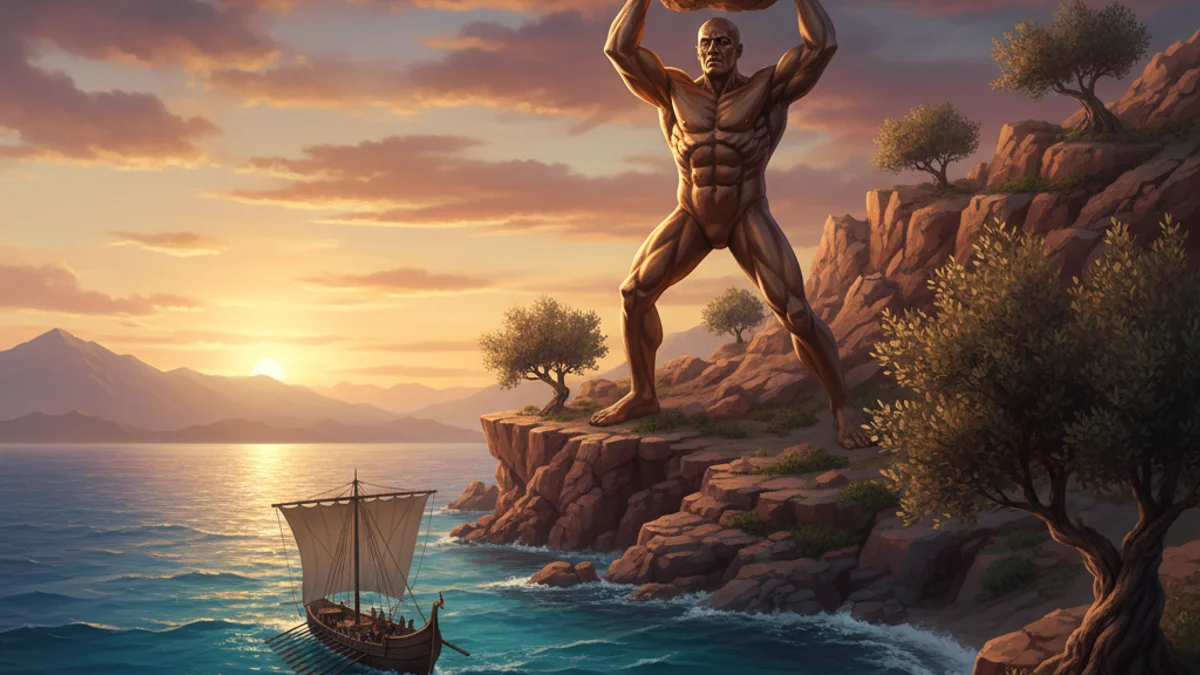
On the sun-drenched shores of ancient Crete stood Talos, a towering colossus forged of gleaming bronze. Created by the god Hephaestus and gifted to King Minos, this mechanical sentinel was the world’s first automaton. Three times a day, Talos strode around the island's perimeter, his heavy footsteps echoing like thunder. When enemy ships approached, he hurled massive boulders or heated his metal body to a red-hot glow, crushing intruders in a lethal embrace. He was invulnerable, save for a single vein running from his neck to his ankle, sealed by a lone bronze nail. His reign ended when the Argonauts arrived. The sorceress Medea used her dark incantations to cloud the giant's mind. In a daze, Talos grazed his ankle on a sharp rock, dislodging the pin. The ichor—the divine blood of the gods—flowed out like molten lead, and the mighty bronze giant toppled into the sea, proving that even the strongest fortress has a fatal flaw.
No matter how invincible someone appears, everyone has a hidden weakness that can be exploited by wisdom and cunning.
Questions about this story
Who created Talos the Bronze Giant?
Talos was most commonly said to be forged by Hephaestus, the god of fire and smithing, as a gift for King Minos of Crete. Some versions suggest he was a gift from Zeus to Europa.
How did Talos die?
He died when the bronze nail in his ankle was removed, allowing his life-sustaining ichor to drain out. This was orchestrated by the sorceress Medea, who used magic or trickery to confuse him.
What was the purpose of Talos?
Talos served as the guardian of Crete, circling the island three times a day to repel invaders. He would throw giant rocks at approaching ships or burn enemies with his heated bronze body.
Is Talos considered the first robot in history?
In mythological terms, yes, Talos is often cited as the first representation of an automaton or robot in Western literature. He was a programmed machine made of metal rather than a living being.
Advertisement

Good night.
