
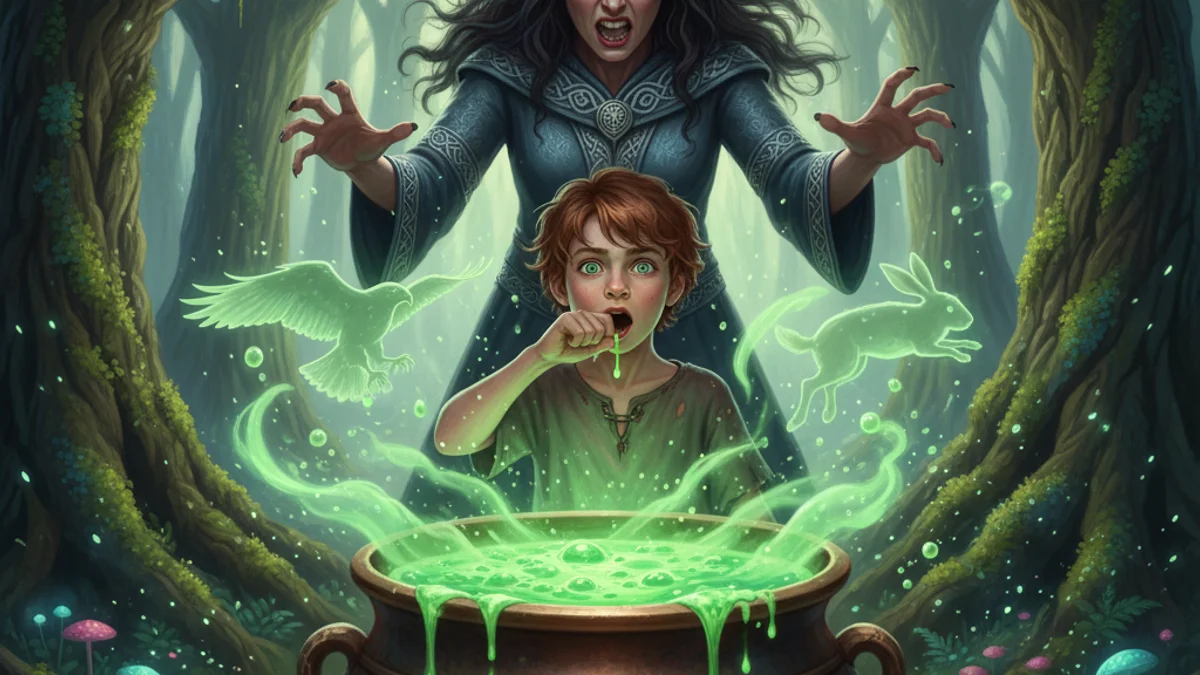
In the ancient lands of Wales, the sorceress Ceridwen brewed a magical cauldron of inspiration to grant divine wisdom to her disfigured son. She tasked a young boy named Gwion Bach with stirring the potion for a year and a day. In the final moments, three scorching drops splashed onto Gwion’s thumb. Instinctively, he sucked his thumb to soothe the burn and instantly gained the cosmic knowledge intended for another. Fleeing Ceridwen’s fury, Gwion utilized his new powers to shift shapes: he became a hare, a fish, and a bird, while Ceridwen pursued him as a greyhound, an otter, and a hawk. Finally, Gwion turned into a single grain of wheat, and Ceridwen, in the form of a black hen, swallowed him. Nine months later, she gave birth to a child of such beauty that she could not bring herself to kill him. She cast him into the sea in a leather bag, where he was eventually rescued by Prince Elphin. Struck by the infant's brilliance, Elphin named him Taliesin, meaning 'Radiant Brow.' The boy grew to be the greatest bard in history, a master of prophecy and song whose wisdom transcended time.
True wisdom and inspiration cannot be forced or manufactured; they are transformative forces that follow their own destined path.
Questions about this story
What is the moral of Taliesin the Bard?
The story suggests that wisdom is a transformative journey that cannot be stolen or assigned to the unworthy. It emphasizes that true inspiration is a gift of destiny that changes the essence of the person who receives it.
Who was Ceridwen in Welsh mythology?
Ceridwen was a powerful enchantress or goddess associated with the cauldron of inspiration, knowledge, and rebirth. In this legend, she is both the antagonist who pursues Gwion and the mother who eventually gives birth to his new form.
How did Gwion Bach become Taliesin?
After consuming three drops of a magical potion, Gwion underwent a series of shape-shifting transformations. He was eventually eaten as a grain of wheat by Ceridwen, reborn as her child, and found in a fishing weir by Prince Elphin, who renamed him.
Was Taliesin a real person?
Yes, historians believe there was a real 6th-century poet named Taliesin who served in the courts of several British kings. Over centuries, his historical identity merged with supernatural folklore to create the legendary figure we know today.
Advertisement
Good night.
