
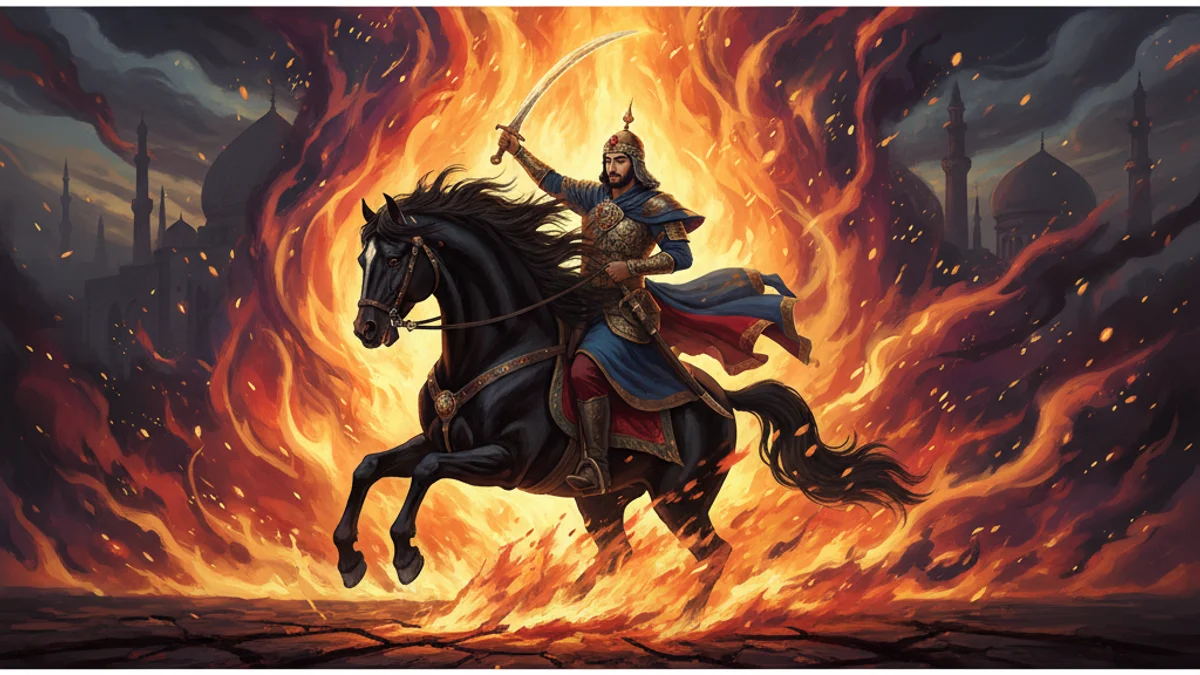
Prince Siyavash was the embodiment of virtue and beauty, raised by the legendary hero Rostam to be the perfect heir to the Persian throne. However, his life took a dark turn when his stepmother, Queen Sudabeh, falsely accused him of betrayal after he rejected her advances. To prove his purity, Siyavash bravely rode his black stallion through a towering mountain of fire, emerging completely unscathed by the flames. Despite his vindication, the atmosphere in his father's court remained toxic. Seeking to prevent a civil war and find true peace, Siyavash crossed the Oxus river into the land of Turan. He was initially welcomed by King Afrasiyab and married the princess Farangis, building a beautiful city of his own. But jealousy soon took root in the heart of the king’s brother, Garsivaz, who poisoned Afrasiyab’s mind with lies of a conspiracy. The innocent prince was captured and unjustly executed. Legend says that where his blood touched the earth, a unique plant called 'Siyavashan' grew, and his death ignited a cycle of vengeance that lasted for generations.
Integrity and honor remain untarnished even in death, but unchecked jealousy and suspicion can destroy the most virtuous souls and lead to endless ruin.
Questions about this story
What is the moral of Siyavash the Prince?
The story highlights the importance of maintaining one's purity and honor in the face of false accusations. It also serves as a warning about how jealousy and courtly intrigue can destroy peace and lead to devastating consequences.
How did Siyavash prove his innocence to his father?
He underwent a 'trial by fire,' a common trope in ancient mythology. He rode his horse through a massive bonfire; because he was innocent of the crimes Sudabeh accused him of, God protected him and he emerged without a single burn.
Why did Siyavash leave Iran for Turan?
Despite proving his innocence, Siyavash realized that the tension at his father's court would never cease. He sought to prevent further bloodshed by seeking refuge with King Afrasiyab, hoping to bridge the gap between the rival nations.
Who betrayed Siyavash in Turan?
He was betrayed by Garsivaz, the brother of King Afrasiyab. Garsivaz grew envious of Siyavash’s popularity and influence, eventually convincing the king through lies that the prince was planning a rebellion.
Advertisement


Good night.
