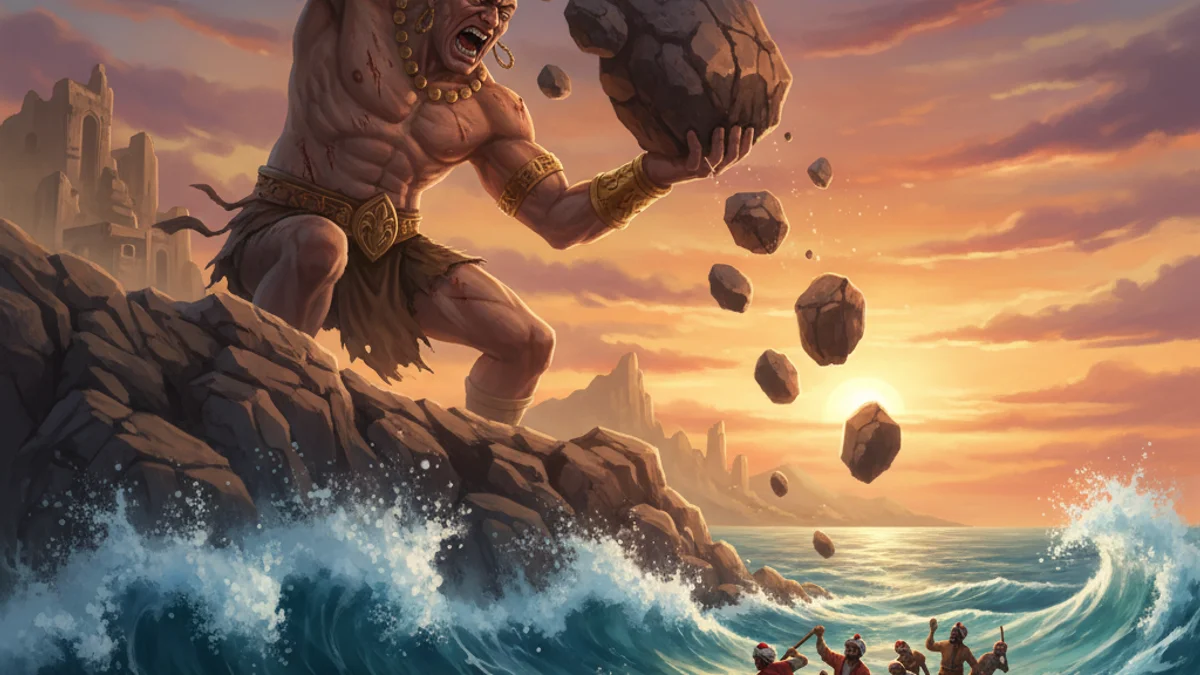
Driven by a restless spirit, Sinbad set sail from Basra for his third voyage. His ship was blown off course to the Mountain of Apes, where a swarm of small, hairy creatures forced the crew ashore and stole their vessel. Seeking refuge in a massive castle, the men were horrified to find a colossal giant with a single eye, skin as black as coal, and tusks like a boar. Each night, the giant would select the fattest sailor, roast him over a fire, and devour him. Desperate to survive, Sinbad devised a plan. While the giant slept, the crew heated two giant iron spits in the hearth and plunged them into the monster's eye. Blinded and roaring in agony, the giant stumbled away. Sinbad and his remaining men fled to the beach and constructed a raft, but the giant returned with others of his kind, hurling massive rocks that sank all but Sinbad's raft. They eventually reached another island, only to encounter a giant serpent that swallowed his companions. Using his ingenuity, Sinbad built a wooden cage around himself to survive the night until a passing ship spotted him, returning him to Baghdad with a renewed appreciation for life.
Resourcefulness and calm deliberation are the best weapons against brute force and seemingly impossible odds.
Questions about this story
What is the moral of Sinbad's Third Voyage?
The moral is that intelligence and quick thinking can overcome physical might. Sinbad survives not through strength, but through his ability to plan and adapt under pressure.
Who is the main antagonist in Sinbad's Third Voyage?
The primary antagonist is a man-eating giant, often described as a black-skinned ogre with a single eye. He is widely considered to be an adaptation of the Cyclops from Greek mythology.
How did Sinbad defeat the giant?
Sinbad and his crew waited for the giant to fall asleep, then blinded him using red-hot iron spits from the giant's own hearth. This allowed them to escape the castle and reach the shore.
What mythological figure does the giant resemble?
The giant bears a striking resemblance to Polyphemus, the Cyclops from Homer's Odyssey. Both stories feature a one-eyed giant who eats sailors and is eventually blinded by the hero.
Advertisement

Good night.
