
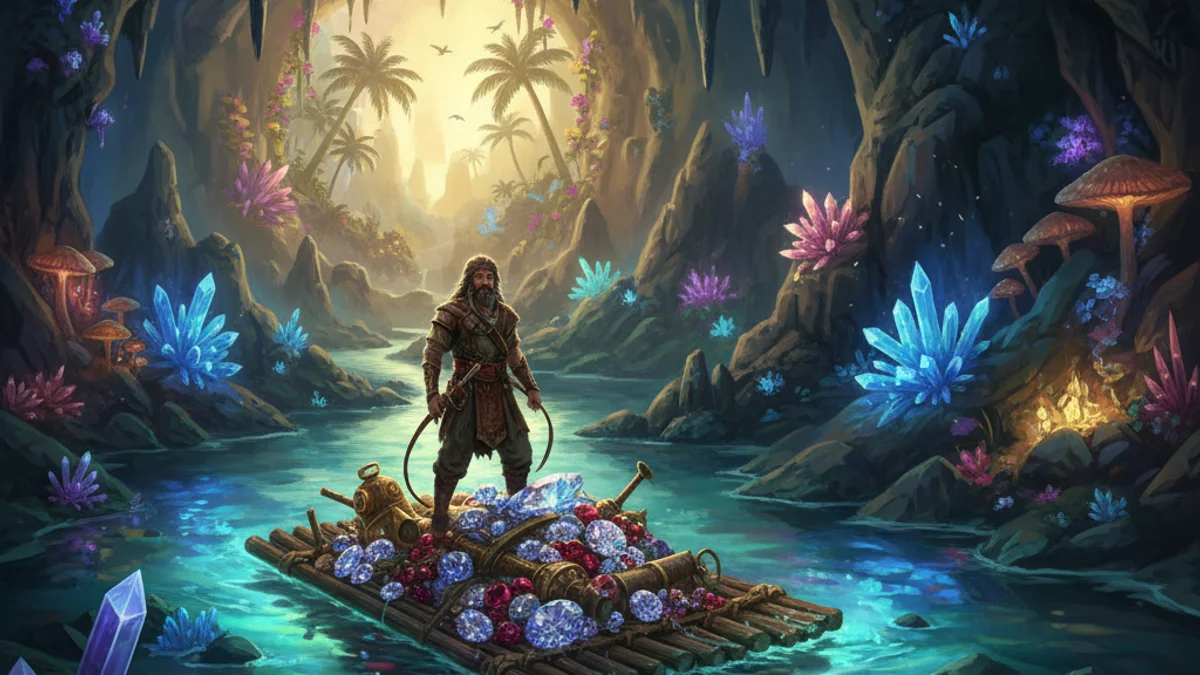
Despite the riches of his previous adventures, Sinbad’s restless spirit drove him to sea for a sixth time. His voyage began prosperously, but a fierce storm blew the ship off course, crashing it against a towering mountain of gems and precious ores. While his companions succumbed to hunger and despair, Sinbad explored the shore, discovering a river of liquid ambergris that flowed into a dark, subterranean cavern. Seeing no other escape, he constructed a sturdy raft from driftwood and loaded it with the finest jewels and treasures from the wrecks littering the beach. He committed himself to the current, drifting through a terrifying, pitch-black tunnel for days. Eventually, the river emerged into the sunlight of the magnificent Kingdom of Serendib. The local people were amazed by his journey and brought him before their King. Sinbad regaled the monarch with tales of the Caliph Harun al-Rashid and the wonders of Baghdad. The King, impressed by Sinbad’s character and the splendor of his home, sent him back to Baghdad with a letter of friendship and a hoard of priceless gifts for the Caliph, ensuring Sinbad returned more famous and wealthy than ever before.
Resourcefulness and unwavering hope in the face of despair can turn a catastrophe into a triumph.
Questions about this story
What is the moral of Sinbad's Sixth Voyage?
The moral is that resilience and resourcefulness are essential in overcoming hardship. Even when all seems lost, Sinbad’s refusal to give up allows him to find a path to safety and even greater wealth.
Where does Sinbad's Sixth Voyage take place?
The story takes place primarily on a remote island mountain and the Kingdom of Serendib, which is the historical Arabic name for modern-day Sri Lanka.
How did Sinbad survive the shipwreck?
While others perished from hunger, Sinbad used his ingenuity to explore the island and discovered a river flowing into a cave. He built a raft and followed the water to find civilization.
What treasures did Sinbad find on the sixth voyage?
He found a shore literally covered in precious gems and a river of ambergris. He filled his raft with these riches before escaping the island through the underground cavern.
Advertisement
Good night.
