
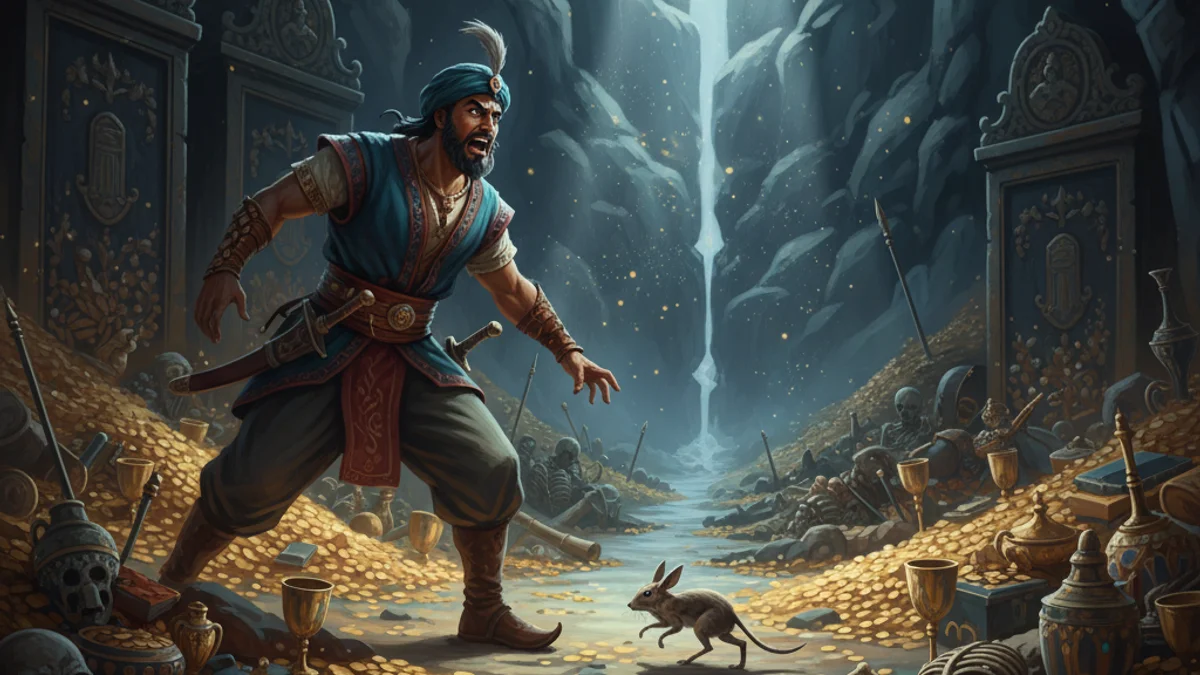
Lured once more by the call of the sea, Sinbad set sail from Basra. However, a violent storm wrecked his ship, casting him and his crew onto an island inhabited by savage cannibals. These creatures fed the sailors a strange herb that robbed them of their reason, fattening them up for slaughter. Sinbad, sensing the danger, refused the plant and escaped into the interior of the island. He eventually reached a civilized kingdom where the King befriended him. Sinbad married a noblewoman and found peace, until he discovered a terrifying law: when a spouse died, the living partner was buried alive with them. When his wife suddenly fell ill and perished, Sinbad was lowered into a deep, dark cavern with only a small supply of bread and water. Trapped in a tomb of the dead, he survived by scavenging from those lowered after him. One day, he spotted a scavenger animal and followed it through a narrow crevice, discovering a hidden path to the sea. He escaped with a hoard of jewels taken from the cavern, eventually flagging down a passing ship to return home to Baghdad.
Even in the darkest of circumstances, one must maintain their wits and never abandon the will to survive.
Questions about this story
What is the moral of Sinbad's Fourth Voyage?
The moral emphasizes the importance of resourcefulness and the instinct for self-preservation. It teaches that one must stay alert and think critically even when faced with overwhelming despair or barbaric customs.
How did Sinbad escape the cannibals?
Sinbad noticed that the herb the cannibals fed his crew made them lose their minds and grow fat. By refusing to eat the plant, he remained thin and alert, allowing him to slip away while his captors were distracted.
What was the horrific custom in the kingdom?
In the kingdom where Sinbad married, the law dictated that if a husband or wife died, the surviving spouse had to be buried alive alongside them in a communal cavern. This ensured that couples were united even in death.
How did Sinbad survive inside the burial cavern?
Sinbad survived by using his meager rations sparingly and, more grimly, by taking the food and water from other people who were subsequently lowered into the tomb. He eventually found a way out by following a wild animal.
Advertisement
Teach next

Good night.
