
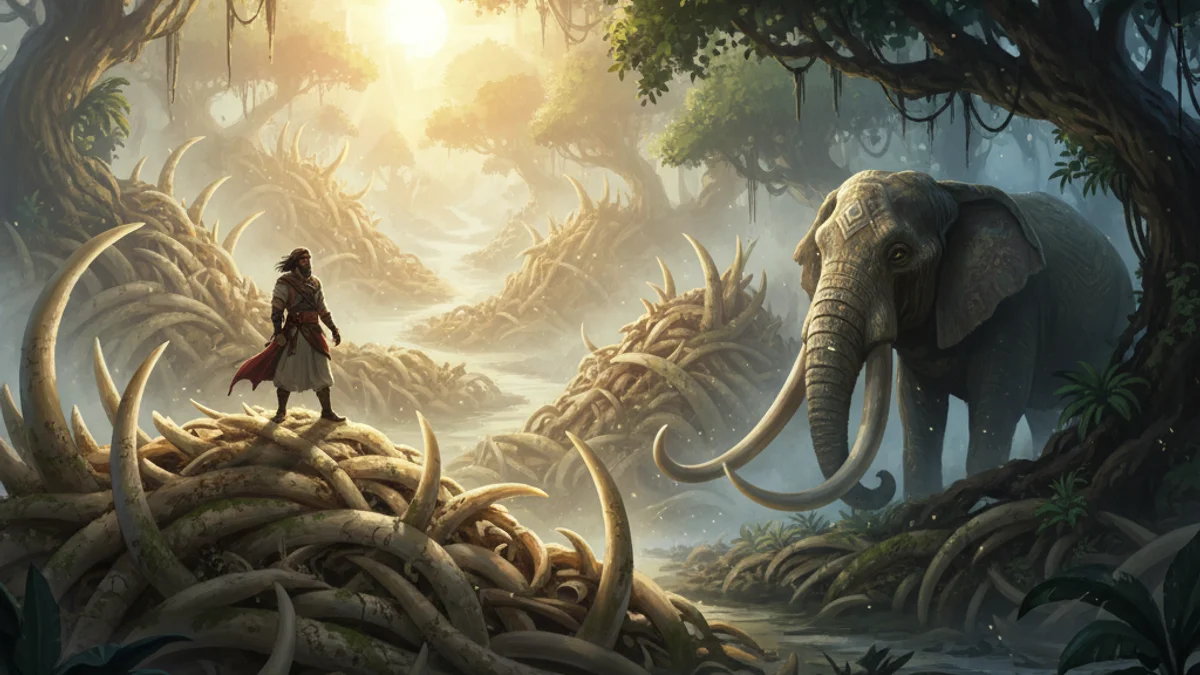
During his seventh and final voyage, Sinbad was captured by a group of men and sold to a wealthy merchant in a distant land. The merchant, desperate for ivory, commanded Sinbad to sit in a tall tree each night and shoot any elephant that passed below. For many days, Sinbad complied, though his heart grew heavy with the slaughter. One night, a massive elephant surrounded his tree with its herd. Instead of trampling him, the great beast uprooted the tree with its trunk and carried a terrified Sinbad deep into the jungle. They arrived at a vast clearing hidden among the mountains, filled with the bones and tusks of countless elephants—a legendary cemetery. Sinbad realized the elephants were showing him that they need not be killed for their ivory; there was enough wealth in the clearing to last a lifetime. He shared this discovery with the merchant, who was so moved by the elephants' wisdom and Sinbad's honesty that he granted the sailor his freedom and a rich portion of the ivory, allowing Sinbad to return to Baghdad in peace.
True prosperity and wealth are found through understanding and respecting the natural world rather than through greed and violence.
Questions about this story
What is the moral of Sinbad and the Elephant Cemetery?
The moral is that compassion and respect for living creatures lead to greater rewards than greed. By showing mercy, Sinbad received a fortune without the need for further bloodshed.
Which voyage of Sinbad features the elephant cemetery?
This event takes place during Sinbad's seventh and final voyage. It serves as the concluding adventure before he retires to a life of peace in Baghdad.
Why did the elephant take Sinbad to the cemetery?
The elephant took him there to stop the killing of the herd. By showing Sinbad where the natural ivory was located, the elephants protected their living members from his arrows.
Is the elephant cemetery a real place?
The 'elephant graveyard' is a popular myth in folklore and fiction. In reality, it likely originated from people finding groups of skeletons near water sources where elderly elephants gathered during droughts.
Advertisement



Good night.
