
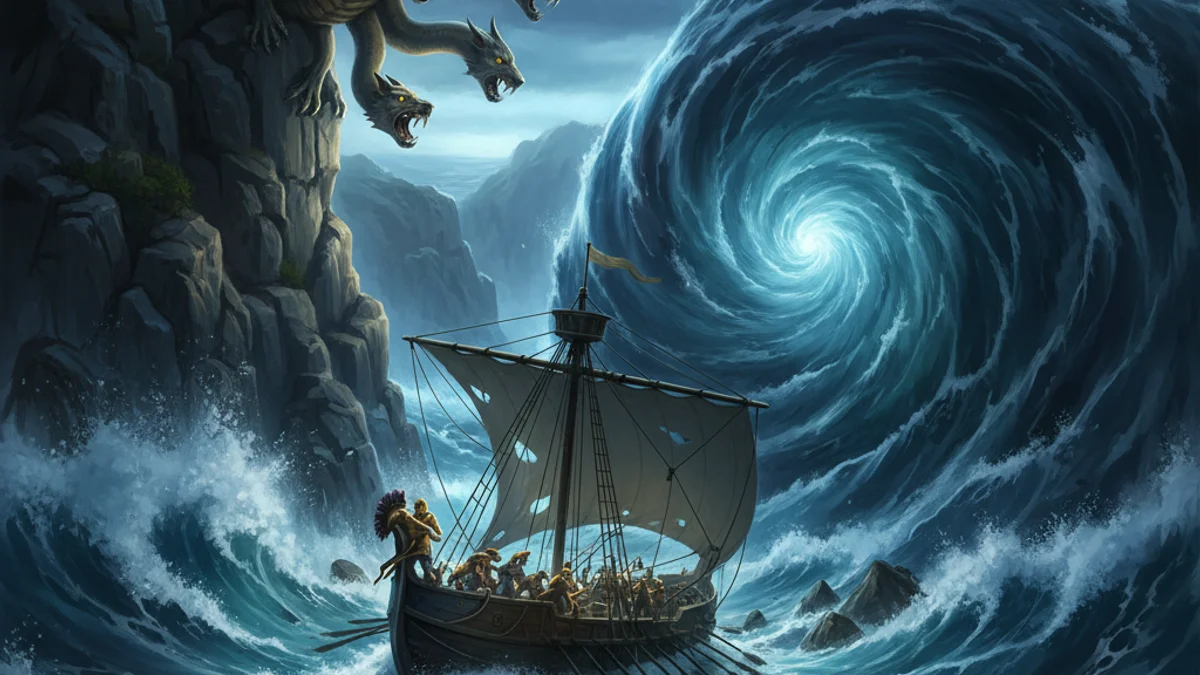
During his long journey home to Ithaca, the hero Odysseus was forced to navigate a narrow strait guarded by two immortal terrors. On one side lived Scylla, a creature with twelve feet and six long, snaky necks, each ending in a head with triple rows of shark-like teeth. On the opposite side lay Charybdis, a monstrous whirlpool that three times a day swallowed the sea and spat it back out. Acting on the advice of the sorceress Circe, Odysseus chose to sail closer to Scylla. He knew that to face Charybdis meant the certain destruction of his entire ship and all his men, whereas Scylla would claim only six. As they passed, the monster's heads darted down, plucking six of his bravest sailors from the deck. Odysseus watched in horror as they were whisked away, but by sacrificing the few, he steered the rest of his crew through the passage to safety, navigating the impossible choice between two certain disasters.
Sometimes life presents two equally difficult options, and wisdom lies in choosing the lesser of two evils to ensure the survival of the whole.
Questions about this story
What is the moral of Scylla and Charybdis?
The story illustrates the concept of 'choosing the lesser of two evils.' It teaches that in impossible situations, a leader must make difficult sacrifices to prevent total catastrophe.
Who were Scylla and Charybdis?
Scylla was a six-headed sea monster who lived on a cliff, while Charybdis was a sentient whirlpool that dwelled beneath a fig tree on the opposite side of the strait.
What does the idiom 'between Scylla and Charybdis' mean?
It is an idiom used to describe a situation where one is caught between two equally unpleasant or dangerous alternatives, similar to being 'between a rock and a hard place.'
How did Odysseus survive the passage?
Following Circe's advice, Odysseus sailed closer to Scylla's cliff. He lost six men to her many heads but avoided the whirlpool that would have sunk his entire vessel.
Advertisement

Good night.
