
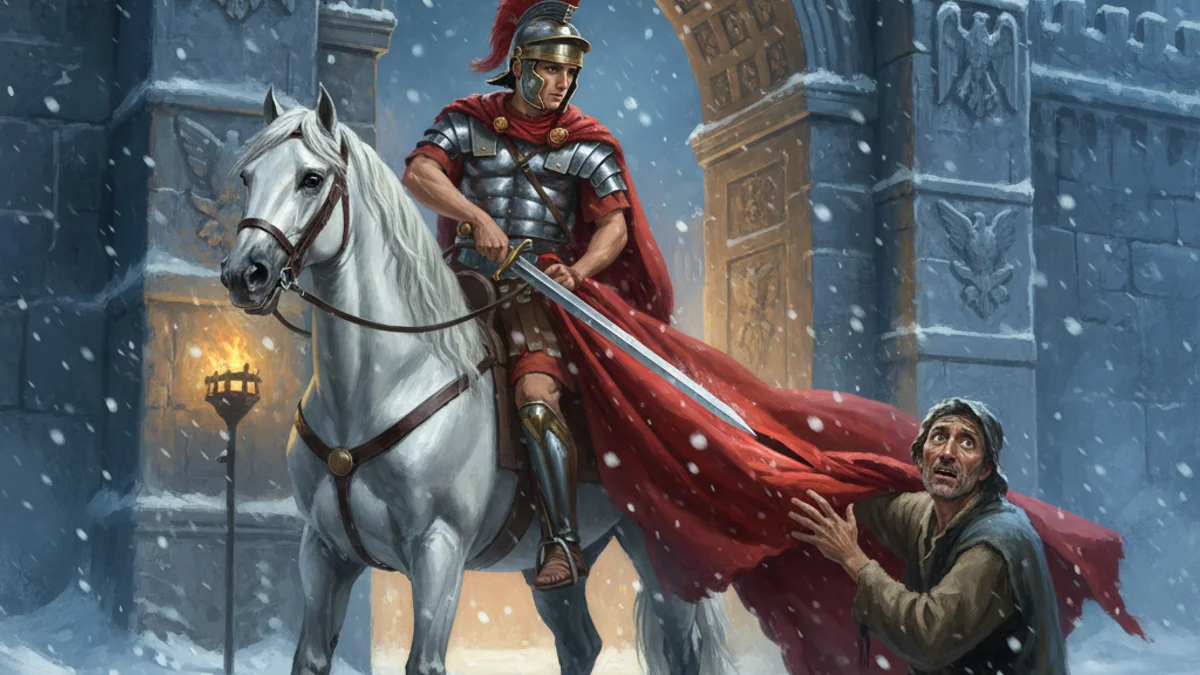
On a bitter winter’s night in Amiens, Gaul, a young Roman soldier named Martin rode his horse toward the city gates. The wind was fierce, and by the gate huddled a beggar, shivering in rags and pleading for help. Martin, having already given away his money to the poor, had nothing left but his military gear and his heavy wool cloak. Seeing the man’s desperation, Martin drew his sword. Rather than striking, he sliced his cloak in two, giving half to the beggar and wrapping the remaining portion around his own shoulders. That night, Martin had a vision: Jesus Christ appeared to him, surrounded by angels and wearing the half-cloak Martin had given away. Christ said to the heavenly host, 'Martin, who is still but a seeker of the faith, clothed me with this robe.' This divine encounter led Martin to be baptized and eventually leave the army to serve the church, becoming one of the most beloved saints in history.
True compassion involves sharing what we have with those in need, for in serving the least among us, we serve the Divine.
Advertisement
Questions about this story
What is the moral of Saint Martin and the Beggar?
The story teaches that selfless charity is the highest virtue. By sharing his only possession, Martin demonstrated that helping the suffering is equivalent to serving Christ himself.
Why did Saint Martin only give half of his cloak?
According to Roman military law, half of a soldier's uniform belonged to the empire and the other half belonged to the soldier. Martin gave the beggar the portion that was legally his to give.
What happened to the half of the cloak Martin kept?
The preserved half-cloak became a famous relic known as the 'capella.' The small building where it was eventually stored was called a 'chapel,' which is the origin of the modern word.
Is Saint Martin and the Beggar a true story?
While based on the historical life of Saint Martin of Tours in the 4th century, the account is a hagiography intended to inspire faith and illustrate his transition from soldier to saint.
Advertisement
