
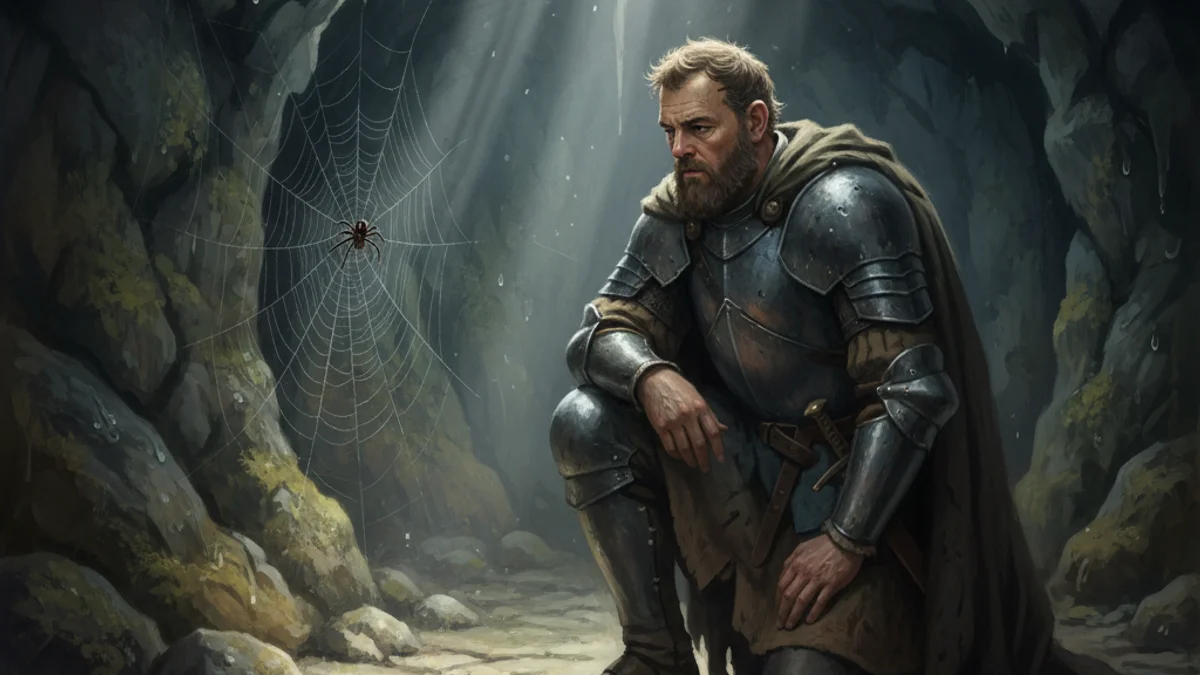
Robert the Bruce, King of Scotland, was at his lowest point. Defeated in six battles against the English, his army was scattered, and he was forced to hide in a cold, damp cave. As he lay there, despairing and ready to give up his crown, he noticed a small spider hanging from a thread. The spider was attempting to swing itself to a nearby beam to start its web. Six times it tried, and six times it fell short. Robert watched, seeing his own failures reflected in the tiny creature. On the seventh attempt, the spider swung with all its might and finally caught the beam. Inspired by the creature's persistence, Robert rose with renewed courage. He gathered his men, fought a seventh time, and eventually secured Scotland's independence at the Battle of Bannockburn.
Perseverance in the face of repeated failure is the path to ultimate success. Never give up, for the next attempt may be the one that triumphs.
Questions about this story
What is the moral of Robert the Bruce?
The story teaches that persistence is vital even after multiple failures. It emphasizes that success often comes to those who refuse to give up and try just one more time.
Who was Robert the Bruce in history?
Robert I was the King of Scots who led Scotland during the First War of Scottish Independence. He is remembered as one of Scotland's greatest national heroes for his military leadership.
Did the spider story really happen?
While Robert the Bruce was a real historical figure, the story of the spider is considered a legend. It was popularized by later writers to illustrate the king's legendary determination.
What was the Battle of Bannockburn?
This was a landmark victory for the Scottish forces led by Robert the Bruce in 1314. It was a decisive moment that eventually led to the recognition of Scottish sovereignty.
Advertisement

Good night.
