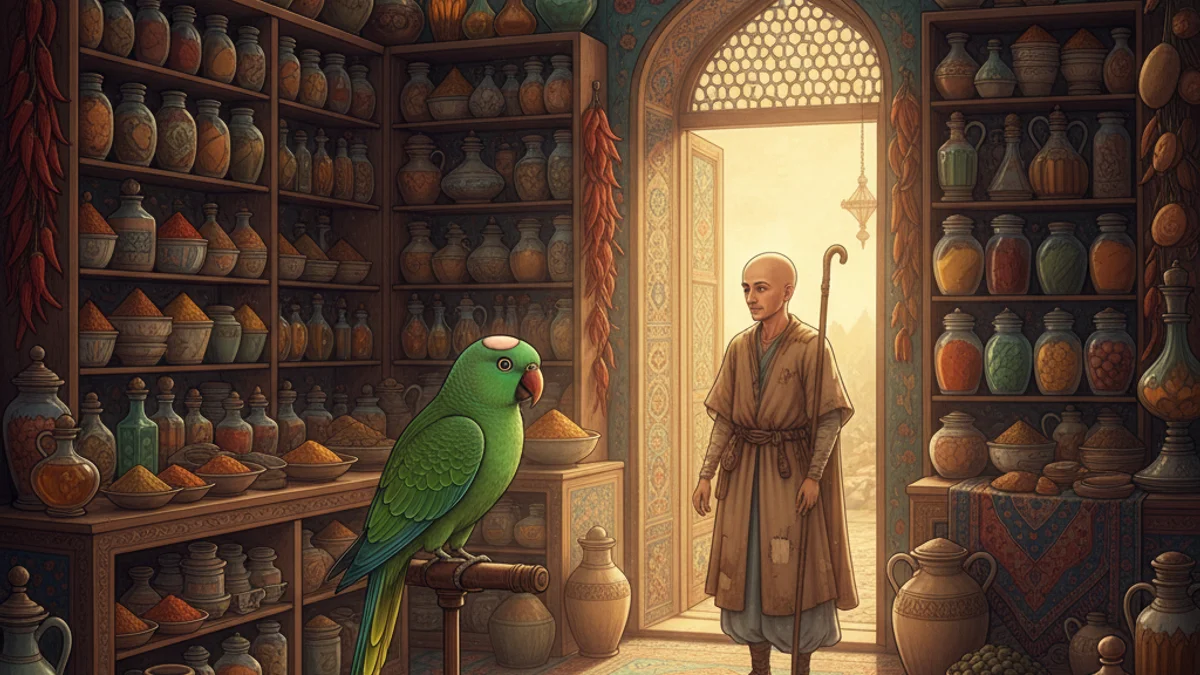
In ancient times, a grocer kept a clever green parrot to guard his shop and entertain customers with its witty speech. One day, while the grocer was out, the parrot took flight and accidentally knocked over a bottle of expensive rose oil, soaking the floor. When the grocer returned and saw the mess, he flew into a rage and struck the bird on the head, causing its feathers to fall out. The once-vibrant bird became bald and, silenced by the trauma, refused to utter a single word for weeks. The grocer, filled with remorse, tried every trick to coax the bird back to speech, but it remained somber. One afternoon, a bald dervish walked past the shop. Upon seeing the man’s smooth scalp, the parrot suddenly broke its silence, shouting, 'Hey, you! Did you also spill a bottle of oil?' The shop erupted in laughter, for the bird assumed the holy man's appearance was caused by the same misfortune it had suffered.
Do not judge the internal states or spiritual rank of others based solely on external appearances or your own limited experiences.
Advertisement
Questions about this story
What is the moral of The Parrot and the Grocer?
The story warns against the fallacy of 'analogy by appearance,' teaching that we should not assume others share our same causes or struggles just because they look similar on the outside.
Who wrote The Parrot and the Grocer?
This parable was written by the famous 13th-century Persian poet and Sufi mystic, Jalal ad-Din Rumi. It is one of the most beloved stories found in his masterpiece, the Masnavi.
What does the parrot represent in Sufism?
The parrot represents the human ego or the intellect that operates only on a surface level. It shows how the mind often projects its own traumas and experiences onto the world around it.
Why is the dervish bald in the story?
In Sufi tradition, a dervish might have a shaved head as a sign of asceticism and devotion. The parrot fails to see this spiritual choice, seeing only a physical trait similar to its own injury.
Advertisement