
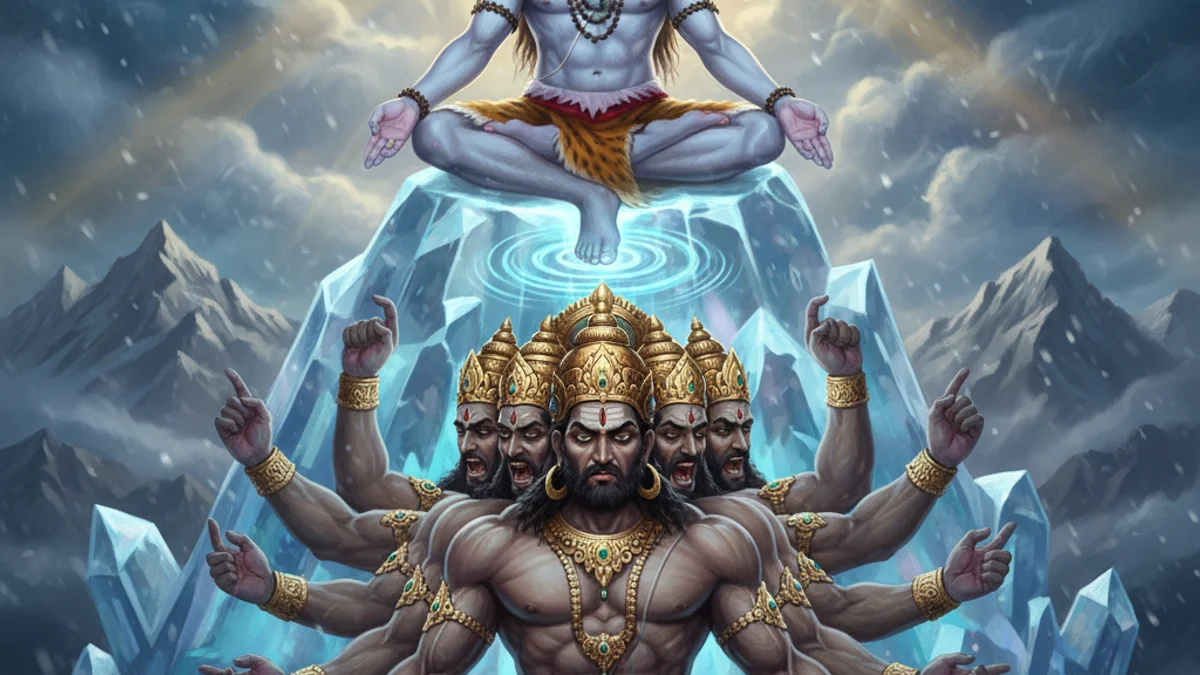
After his victory over Kubera, the mighty ten-headed demon king Ravana flew his celestial chariot toward the Himalayas. His path was blocked by Nandi, the divine bull, who informed him that Lord Shiva and Parvati were resting on Mount Kailash and no one could pass. Insulted, Ravana mocked Nandi’s appearance. Nandi cursed the king, prophesying that monkeys would one day destroy his empire. Infuriated by the obstacle, Ravana decided to uproot the mountain entirely. He reached his twenty arms beneath the base and began to lift. As the mountain trembled, Parvati grew frightened, but Shiva remained calm. With a slight smile, Shiva pressed his big toe down. The sudden weight crushed Ravana’s arms beneath the mountain. Ravana let out a roar so terrifying it shook the three worlds. Realizing his folly, he spent a thousand years singing hymns in praise of Shiva, composing the powerful Shiva Tandava Stotram. Pleased by his devotion, Shiva released him and bestowed upon him the name Ravana—the one who roars.
True strength lies in humility and devotion, while arrogance inevitably leads to a crushing downfall.
Advertisement
Questions about this story
Why did Ravana try to lift Mount Kailash?
Ravana tried to lift the mountain because his path was blocked by Nandi, and he wanted to show his supreme strength by removing the obstacle entirely.
How did Lord Shiva stop Ravana?
Lord Shiva simply pressed his big toe onto the mountain, which instantly increased its weight and trapped Ravana's arms beneath it.
What is the origin of the name Ravana?
The name means 'the one who roars.' It was given to him by Shiva because of the terrifying cry Ravana let out when his hands were crushed under the mountain.
What did Ravana compose while trapped?
During his penance under the mountain, Ravana composed and sang the Shiva Tandava Stotram, a famous hymn praising Lord Shiva's cosmic dance.
Advertisement
