
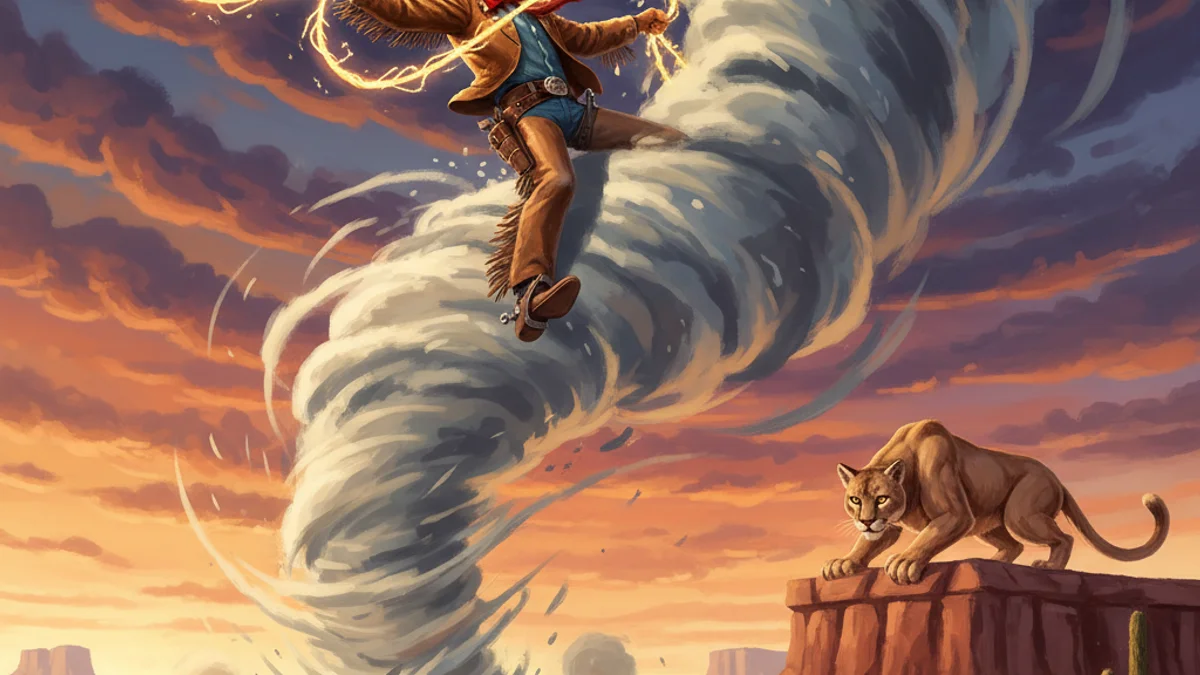
Born to pioneers crossing Texas, baby Bill fell out of the wagon near the Pecos River and was left behind. He was discovered and raised by a pack of coyotes, growing up believing he was a four-legged predator until a wandering cowboy convinced him of his humanity. Embracing his new life, Bill became the greatest cowboy to ever live. He rode a mountain lion named Widow-Maker, used a live rattlesnake for a whip, and famously lassoed a cyclone during a drought. He rode that bucking storm across the plains until it rained itself out, carving the Grand Canyon in the process. His heart was eventually won by the fearless Slue-Foot Sue, who rode a giant catfish. Though their wedding ended with Sue bouncing all the way to the moon on her steel-spring bustle, Bill’s legend as the ultimate tamer of the Wild West remains etched in American folklore.
Adaptability and courage can help a person conquer even the wildest environments and most daunting challenges.
Questions about this story
What is the moral of Pecos Bill?
The story emphasizes that resourcefulness and a fearless spirit allow a person to master their surroundings. It also suggests that our identity is shaped by our choices rather than just our upbringing.
Was Pecos Bill a real person?
No, Pecos Bill is a 'fakelore' character created by writer Edward O'Reilly in 1917. He was designed to embody the spirit and exaggerated heroism of the American cowboy.
Who was Pecos Bill's wife?
His wife was Slue-Foot Sue, a daring woman who was famous for riding a giant catfish down the Rio Grande. She was just as wild and skilled as Bill himself.
How did Pecos Bill tame the cyclone?
During a severe drought, Bill used his lasso to catch a lethal tornado. He jumped on its back and rode it until it was exhausted, forcing it to rain on the parched land.
Advertisement


Good night.
