
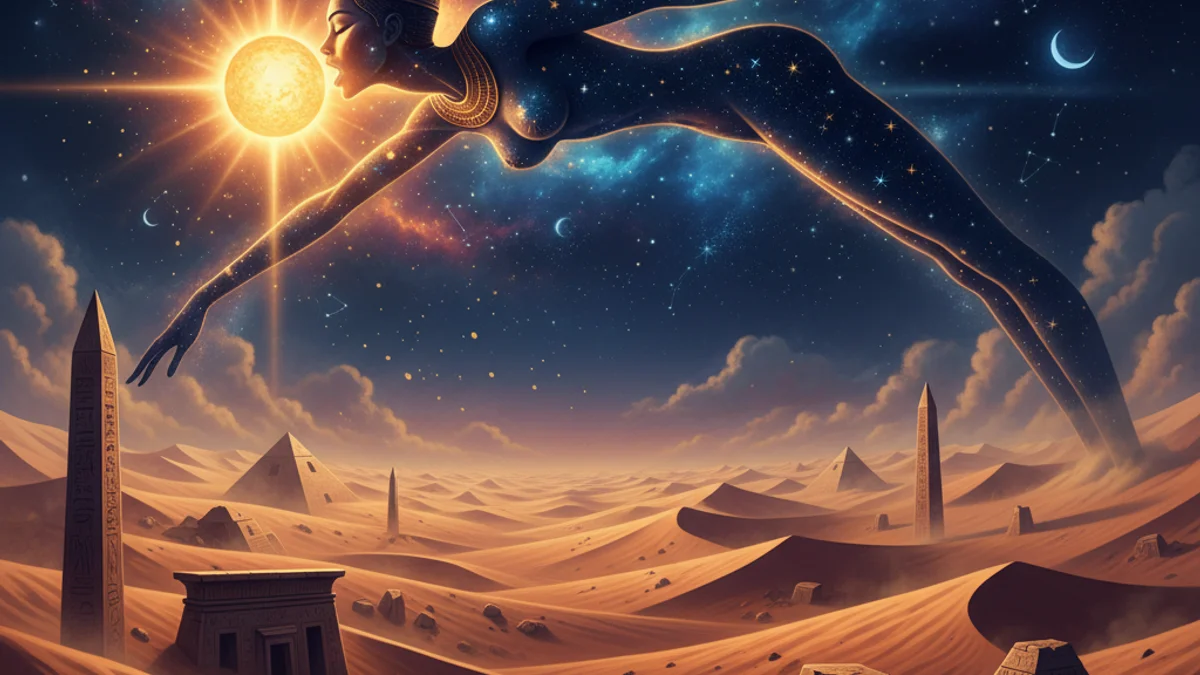
In the cosmology of ancient Egypt, the sky was the body of the goddess Nut, who arched over her husband Geb, the earth. Every evening as the shadows lengthened, the sun god Ra, traveling in his solar barque, reached the western horizon. There, Nut would lean down and swallow the golden orb. During the twelve hours of darkness, the sun traveled through Nut's star-speckled body, navigating the treacherous realm of the Duat. This journey was a period of renewal and a battle against the forces of chaos. As the first light of dawn touched the horizon, Nut gave birth to the sun once more, watching it rise from her thighs as a fresh, glowing child. This eternal cycle of consumption and rebirth ensured that light would always return, maintaining Ma'at, the divine order of the universe.
The cycle of life, death, and rebirth is eternal; every ending is merely the preparation for a new beginning.
Questions about this story
What is the moral of Nut Swallows the Sun?
The moral is that life is a continuous cycle of renewal. It teaches that darkness and endings are not final, but necessary transitions that lead to a fresh dawn and rebirth.
Who is the goddess Nut in Egyptian mythology?
Nut is the goddess of the sky, stars, and the cosmos. She is usually depicted as a woman covered in stars, arching over the earth god Geb to protect the world.
Why does Nut swallow the sun every night?
She swallows the sun god Ra to allow him to pass through her body, which represents the underworld or Duat. This journey purifies and regenerates the sun for the coming day.
What happens to the sun during the night?
Inside Nut's body, the sun travels through the twelve hours of the night. During this time, the sun god must overcome various obstacles and enemies to ensure the sun can rise again.
Advertisement
Good night.
