Story Summary
Discover the wit of Nasrudin and the King. In this Sufi parable, Mulla Nasrudin uses a logical paradox to escape a death decree and challenge the nature of truth.
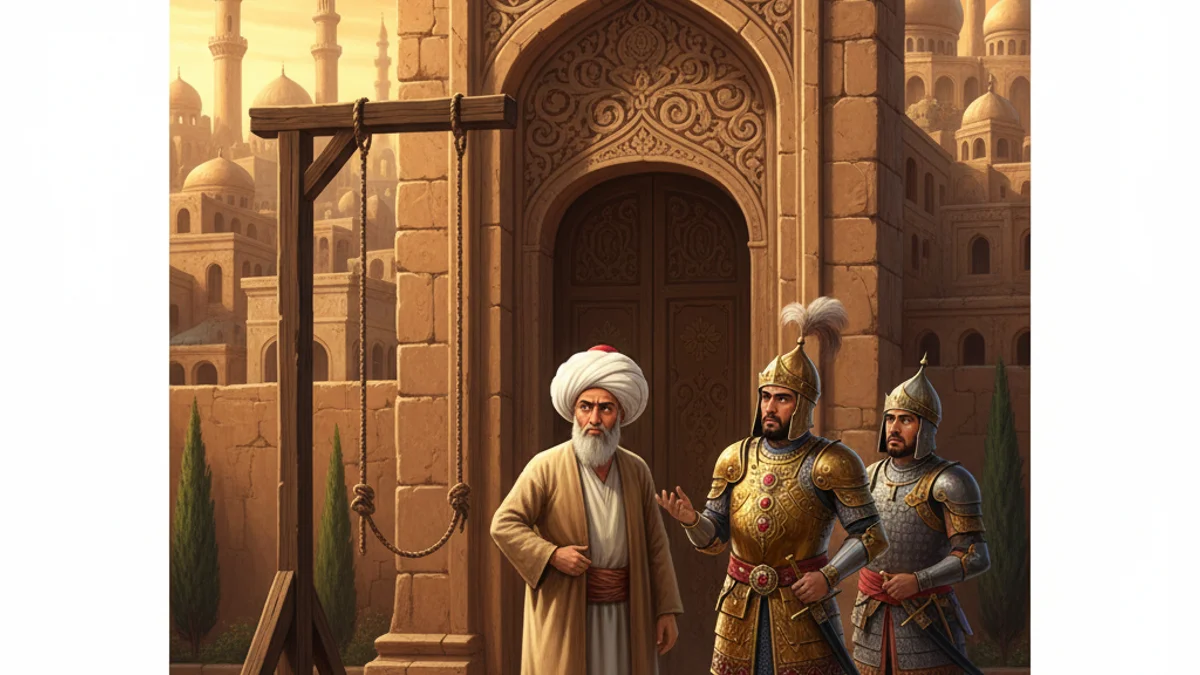
The King of the land, weary of the perceived deceit of his subjects, erected a gallows at the city gates. He decreed that every traveler must answer one question: 'Where are you going?' If they told the truth, they could pass. If they lied, they would be hanged. When Mulla Nasrudin approached the gate, the Captain of the Guard asked him the fateful question. Nasrudin replied calmly, 'I am going to be hanged on those gallows.' This answer threw the guards into a panic. If they hanged him, his statement would have been the truth, and therefore he should have been allowed to pass. If they let him pass, his statement would have been a lie, and he should have been hanged. Faced with this impossible paradox, the King was forced to let Nasrudin go, realizing that his rigid law was no match for the Mulla's wit.
The Moral
Truth is a complex reality that cannot be captured by rigid laws or physical force; wisdom often lies in the paradoxes that logic cannot resolve.
“I am going to be hanged on those gallows.”
Fun Fact
Mulla Nasrudin is so culturally significant that UNESCO declared 1996-1997 as the International Nasreddin Year to celebrate his contributions to folklore and philosophy.
Frequently Asked Questions
What is the moral of Nasrudin and the King?
The moral is that truth is not always black and white and cannot be easily legislated by authority. Nasrudin demonstrates that rigid systems of justice often fail when faced with the complexity of human wit and logical paradox.
Who is Mulla Nasrudin in Sufi tradition?
Mulla Nasrudin is a legendary 'wise fool' character appearing in thousands of stories across the Islamic world. He serves as a vehicle for Sufi teachings, using humor and absurdity to reveal deeper spiritual and philosophical truths.
What is the logical paradox used in this story?
Nasrudin uses a variation of the 'Liar's Paradox.' By claiming his destination is the gallows, he creates a situation where the execution itself would retroactively make his statement true, thereby making the execution a violation of the law.
Why did the King want to hang people for lying?
The King believed that he could force his subjects into honesty through fear and absolute law. He represents a ruler who values control and literalism over the nuanced and often contradictory nature of reality.
What does the gallows symbolize in the tale?
The gallows symbolizes the rigid, life-or-death consequences of dogmatic thinking. Nasrudin’s ability to walk past them represents the triumph of spiritual wisdom and intellectual flexibility over state-imposed force.
Is this story part of a specific collection?
This story is part of the vast oral and written tradition of Nasrudin tales, which have been collected by various authors, including Idries Shah, to illustrate Sufi psychological and spiritual concepts.
Discussion (0)
Share your thoughts on this story
No comments yet. Be the first to share your thoughts!