
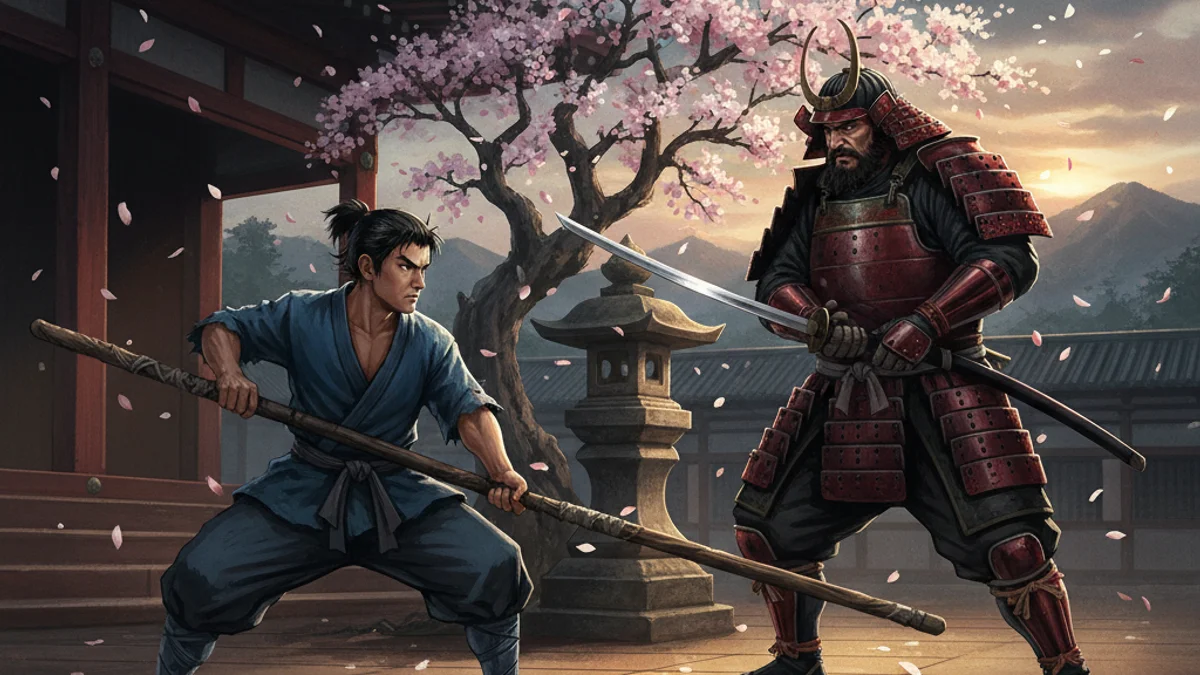
In the village of Hirafuku, a brash samurai named Arima Kihei posted a public challenge on a wooden placard, seeking any opponent willing to face him. While seasoned warriors hesitated, a thirteen-year-old boy named Shinmen Takezo—the boy who would become Miyamoto Musashi—wrote his name upon the board. His uncle, a monk, was horrified and attempted to apologize on the boy's behalf, but Kihei demanded satisfaction. On the day of the duel, the crowd expected a slaughter. Instead, young Takezo charged with a six-foot wooden staff. Kihei drew his steel blade, but the boy's speed and raw ferocity were overwhelming. With a powerful strike to the head followed by a series of relentless blows, the boy killed the veteran samurai. This victory at the temple of Shoren-in marked the birth of a legend, proving that even a child possessed of extraordinary will could topple a master.
True strength is found in the courage to act when others hesitate and the conviction to trust one's own instincts.
Questions about this story
What is the moral of Musashi's First Duel?
The moral is that courage and decisive action are more important than age or status. It teaches that a focused mind and unwavering determination can overcome even the most experienced opponent.
How old was Miyamoto Musashi during his first duel?
Musashi was only thirteen years old when he accepted the challenge. His victory at such a young age established his reputation as a prodigy in the martial arts.
Who was Arima Kihei in the legend?
Arima Kihei was a traveling samurai and master of the Shinto-ryu style. He was an arrogant warrior who met his end after underestimating the young Musashi.
What weapon did Musashi use in his first fight?
Musashi used a wooden staff (bo) against Kihei's steel sword. His ability to win with a blunt training tool against a lethal blade became a hallmark of his legendary skill.
Advertisement
Good night.
