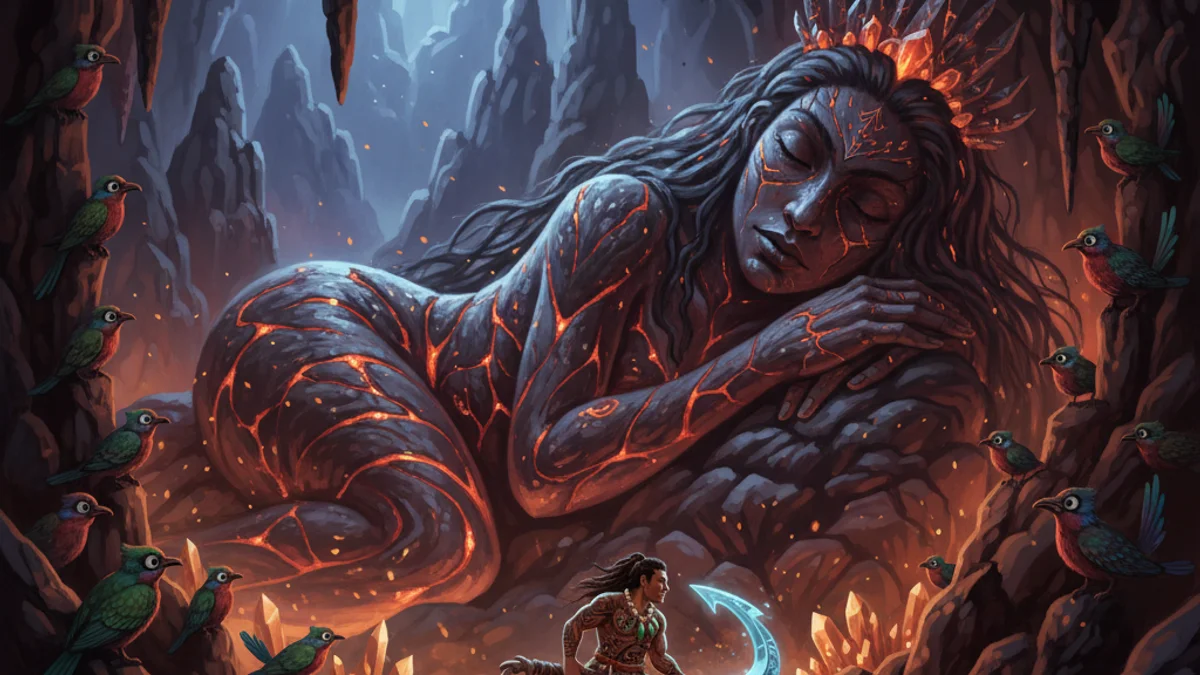
Maui, the legendary demigod who fished up islands and slowed the sun, sought one final victory: the gift of immortality for humanity. He traveled to the edges of the world to find Hine-nui-te-po, the Great Woman of the Night and ruler of the underworld. Maui intended to enter the goddess's body while she slept, believing that if he could pass through her and emerge from her mouth, the power of death would be broken forever. He brought with him a group of forest birds, strictly warning them to remain silent until his task was finished. As Maui began his daring journey, the tiny Piwakawaka (fantail) could not contain its mirth at the sight of the hero's struggle and burst into a fit of chirping laughter. The sound startled Hine-nui-te-po from her slumber. Awakening instantly, she realized Maui's intent and crushed him with her powerful thighs. Because of this failure, Maui became the first of his kind to perish, and mortality remained the permanent fate of all mankind.
Death is an inescapable and natural part of the human cycle that cannot be overcome even by the greatest of heroes.
Advertisement
Questions about this story
What is the moral of Maui and Hine-nui-te-po?
The moral is that death is an inevitable part of the natural order. It teaches that hubris cannot bypass the cycle of life and that mortality defines the human experience.
Why did Maui want to conquer Hine-nui-te-po?
Maui wanted to end the suffering caused by death and grant humans eternal life. He hoped to make people like the moon, which dies every month but returns to life again.
Which bird is blamed for Maui's death?
The Piwakawaka, or the fantail bird, is blamed for Maui's death. Its uncontrollable laughter woke the Goddess of Night, leading to Maui's immediate demise.
How did Hine-nui-te-po become the Goddess of Death?
Originally known as Hine-titama, she fled to the underworld after discovering the true identity of her husband. There, she took the name Hine-nui-te-po to receive the spirits of her children.
Advertisement