
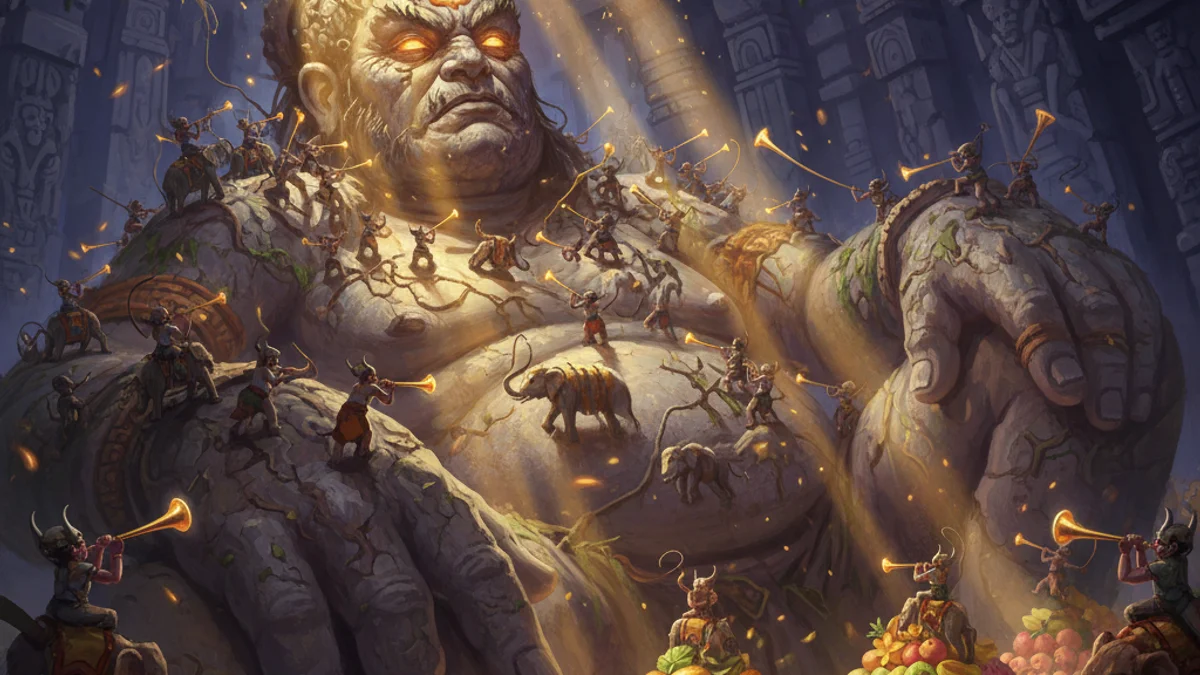
In the heart of the great war of Lanka, Ravana found his forces dwindling against the might of Lord Rama and his vanara army. In desperation, he turned to his younger brother, the giant Kumbhakarna, who was cursed by Brahma to sleep for six months at a time. Waking him was no small feat. Thousands of rakshasas gathered, blowing conchs, beating massive drums, and shouting with all their might. They brought mountains of meat and rivers of wine to tempt his senses. They even drove herds of elephants over his massive body. Finally, the earth-shaking giant stirred and awoke. Though Kumbhakarna reprimanded Ravana for kidnapping Sita and ignored his brother’s folly, his sense of kinship was absolute. He knew the path led to death, yet out of loyalty, he marched onto the battlefield. Towering over the armies, he caused havoc until he finally met Lord Rama. Despite his incredible power, Kumbhakarna was eventually slain by Rama’s divine arrows, attaining liberation in his final moments while fulfilling his duty to his brother.
Blind loyalty to family over righteousness can lead to tragedy, even for those who recognize the truth.
Questions about this story
What is the moral of Kumbhakarna Awakens?
The story teaches that loyalty is a virtue, but when placed above morality and righteousness, it leads to one's downfall. Kumbhakarna chose his brother over dharma, knowing it would result in his death.
Why did Kumbhakarna sleep for six months?
Kumbhakarna intended to ask Lord Brahma for 'Indrasana' (the throne of Indra), but the goddess Saraswati tied his tongue. Instead, he asked for 'Nidrasana' (the bed of sleep), leading to his six-month slumber.
How did Ravana's army wake Kumbhakarna?
The demons used an extreme combination of loud noises from drums and trumpets, the scent of piles of food, and physical force. They even used elephants to trample his body until he finally felt the pressure and woke up.
Did Kumbhakarna agree with Ravana's actions?
No, Kumbhakarna actually criticized Ravana for his arrogance and for kidnapping Sita. However, he believed his duty as a brother outweighed his personal judgment of Ravana's sins.
Advertisement
Good night.
