
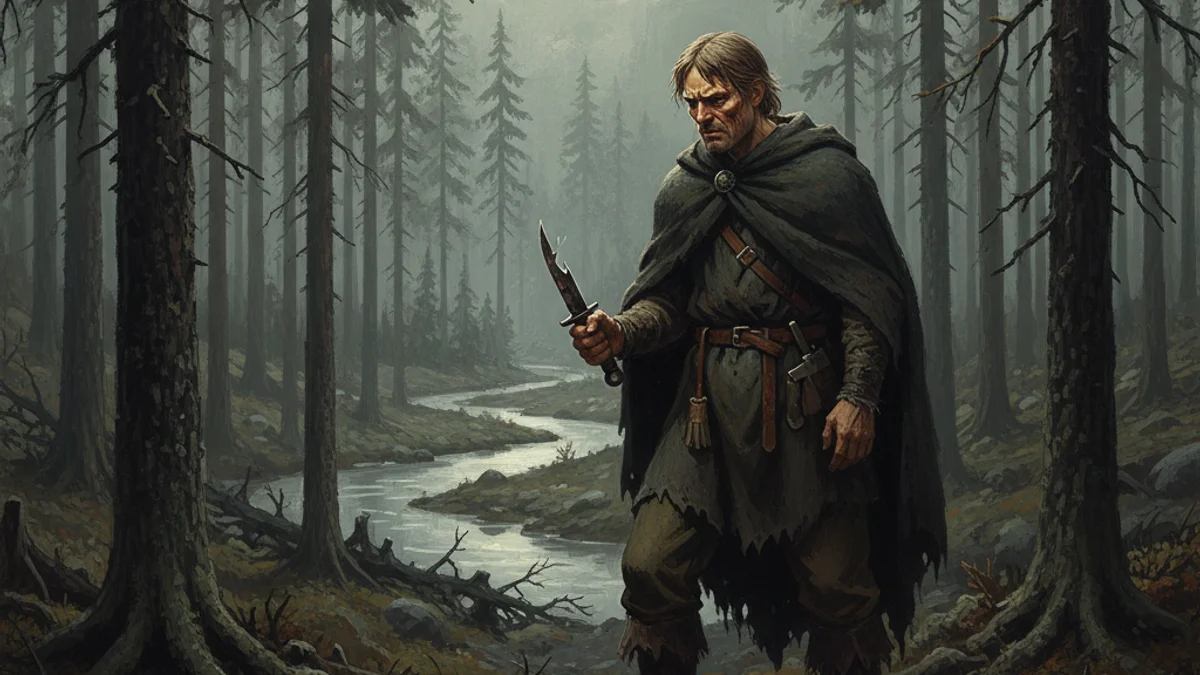
Kullervo, born into a bitter feud between the brothers Kalervo and Untamo, was a child of immense strength and relentless misfortune. After Untamo slaughtered his kin, Kullervo was kept as a slave, but his supernatural power made him impossible to break. Eventually sold to the blacksmith Ilmarinen, he was further tormented by the smith's cruel wife, who baked a stone into his bread. When Kullervo broke his only heirloom knife on the stone, his rage overflowed; he summoned a pack of wolves to tear his mistress apart. Fleeing into the wilderness, he miraculously discovered his parents were still alive, yet tragedy continued to haunt his steps. Unknowingly, he seduced a young woman who was revealed to be his own long-lost sister; upon learning the truth, she cast herself into a rushing river. Consumed by grief and having finally exacted a bloody revenge on Untamo’s tribe, Kullervo returned to the forest. He asked his black-holed sword if it would drink the blood of a guilty man. The blade replied that it would gladly feast on the blood of the innocent and the guilty alike, and Kullervo threw himself upon the point, ending his sorrowful life.
Unchecked vengeance and the cycle of hatred provide no solace, ultimately destroying both the seeker and the innocent.
Questions about this story
What is the moral of Kullervo's Tragedy?
The story serves as a warning that a life built on vengeance and hatred leads to a path of self-destruction. It illustrates how trauma, when left unhealed, can spiral into a cycle of violence that consumes everyone involved.
Who is Kullervo in Finnish mythology?
Kullervo is the central tragic anti-hero of the Kalevala, Finland's national epic. He is a character defined by his supernatural strength, a series of unfortunate events, and a curse that brings ruin to his family.
How does Kullervo die in the Kalevala?
Kullervo commits suicide by falling on his own sword. Before doing so, he asks the sword if it is willing to kill him, and the weapon speaks, agreeing to drink his blood because of his heavy guilt.
Did Kullervo inspire J.R.R. Tolkien?
Yes, Kullervo was the primary inspiration for Tolkien’s character Túrin Turambar in 'The Silmarillion.' Tolkien was deeply moved by the Finnish language and the tragic nature of the Kullervo myth during his studies.
Advertisement


Good night.
