
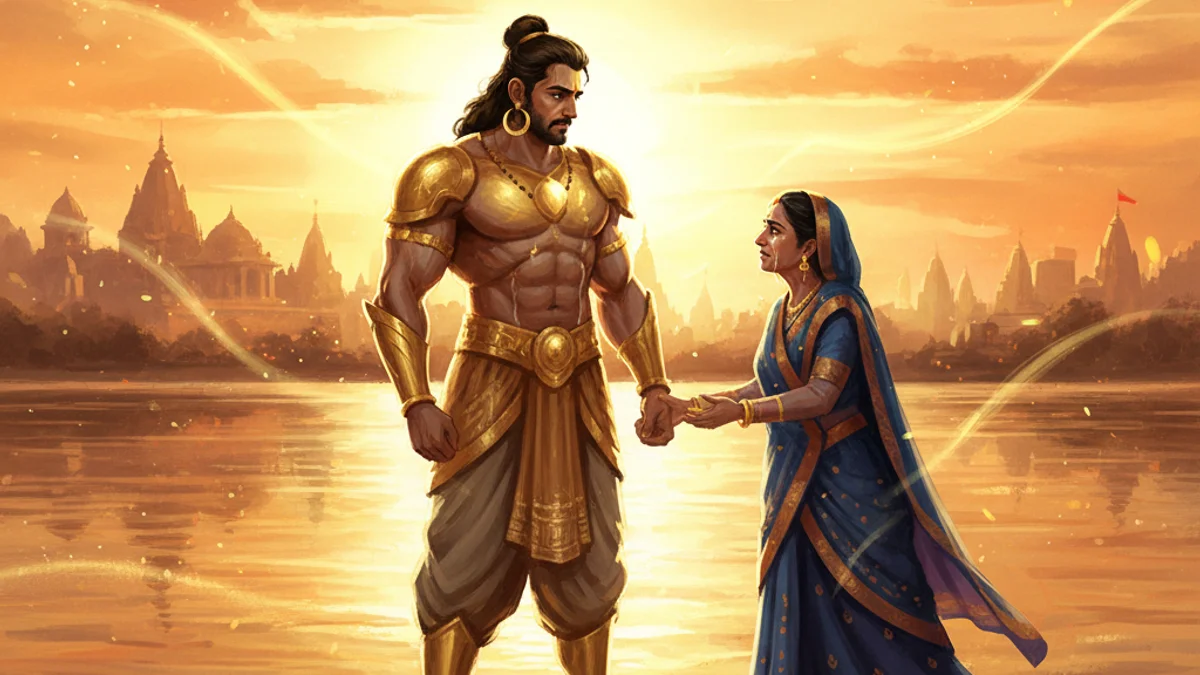
Long ago, Princess Kunti received a divine mantra to summon any deity. Testing its power, she called upon Surya, the Sun God, who blessed her with a son born with golden armor and earrings. Fearing social disgrace as an unwed mother, Kunti placed the infant in a basket and set him afloat on the Ganges. The boy was found and raised by a charioteer named Adhiratha and his wife Radha. Named Karna, the boy grew into a warrior of unmatched skill, yet he was constantly mocked for his low-caste upbringing. Only Duryodhana, the Kaurava prince, treated him as an equal, making him the King of Anga. On the eve of the Great Kurukshetra War, Kunti finally approached Karna by the river. She revealed the shocking truth: he was her eldest son and the brother of the Pandavas he was sworn to fight. Lord Krishna also offered him the crown of India if he switched sides. However, Karna refused. He told Kunti that while she abandoned him, his friend Duryodhana had given him honor. Choosing loyalty over blood, Karna stayed with his friend, accepting his tragic destiny as the unsung hero of the Mahabharata.
True nobility is defined by one's character and loyalty rather than the circumstances of their birth.
Questions about this story
What is the moral of Karna's True Identity?
The moral is that loyalty and character outweigh birthright. Karna chose to honor the friend who supported him rather than claim a kingdom based on a biological secret revealed too late.
Who were Karna's biological parents?
Karna was the son of Kunti, the mother of the Pandavas, and Surya, the Sun God. He was conceived through a divine mantra before Kunti was married.
Why did Kunti abandon Karna as a baby?
Kunti was an unmarried princess at the time and feared that having a child out of wedlock would bring immense social shame and ruin her family's reputation.
How did Karna react to learning his true identity?
Karna was deeply moved but remained steadfast. He felt it was unfair of Kunti to reveal the truth only to save her other sons, and he refused to betray Duryodhana's lifelong friendship.
Advertisement
Good night.
