
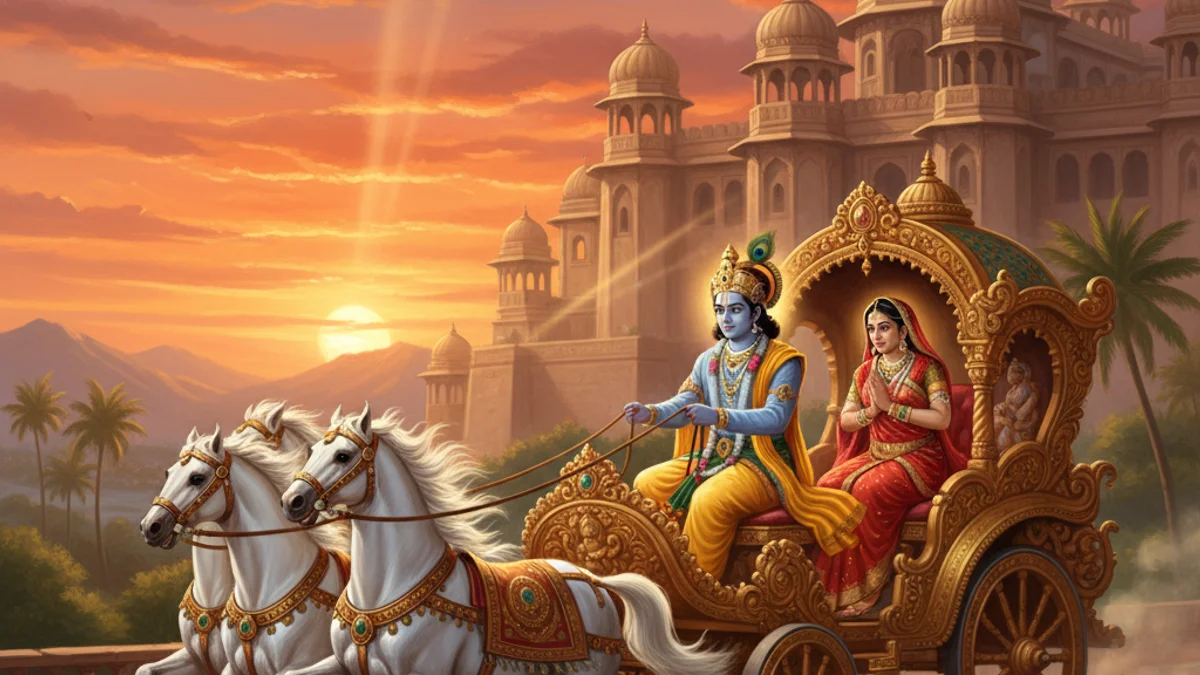
Princess Rukmini of Vidarbha had heard of Krishna’s grace and valor, losing her heart to him long before they ever met. However, her brother Rukmi, driven by political ambition, arranged her marriage to the wicked King Shishupala. Desperate, Rukmini sent a secret letter to Krishna via a trusted priest, declaring that she would rather die than marry anyone else. She proposed a plan for him to whisk her away during her visit to the temple of Goddess Parvati. On the day of the wedding, as Rukmini emerged from the temple, Krishna appeared in his chariot, lifting her up before the stunned eyes of the gathered kings. A fierce battle ensued as Rukmi pursued them, but Krishna defeated him and spared his life only at Rukmini's request. They reached Dwarka, where they were wed in a grand ceremony, marking a union of divine love and steadfast devotion.
True love and sincere devotion are always answered by the divine, regardless of the obstacles standing in the way.
Questions about this story
What is the moral of Krishna and Rukmini?
The story teaches that if a devotee calls out to God with pure intention and surrender, God will surely come to their aid. It also highlights that love based on virtue is stronger than political alliances.
Why did Rukmini write a letter to Krishna?
Rukmini wrote the letter because her brother Rukmi was forcing her to marry Shishupala against her will. She loved Krishna for his divine qualities and chose him as her husband in her heart.
Who was Shishupala in this story?
Shishupala was the King of Chedi and a cousin of Krishna, but he was known for his arrogance and wickedness. He was the suitor chosen by Rukmini's brother to marry her.
What is 'Rukmini Haran'?
'Rukmini Haran' refers to the episode where Krishna abducts Rukmini with her consent. In ancient Vedic culture, this was recognized as 'Rakshasa Vivaha,' though it was later sanctified as a marriage of love.
Advertisement
Good night.
