
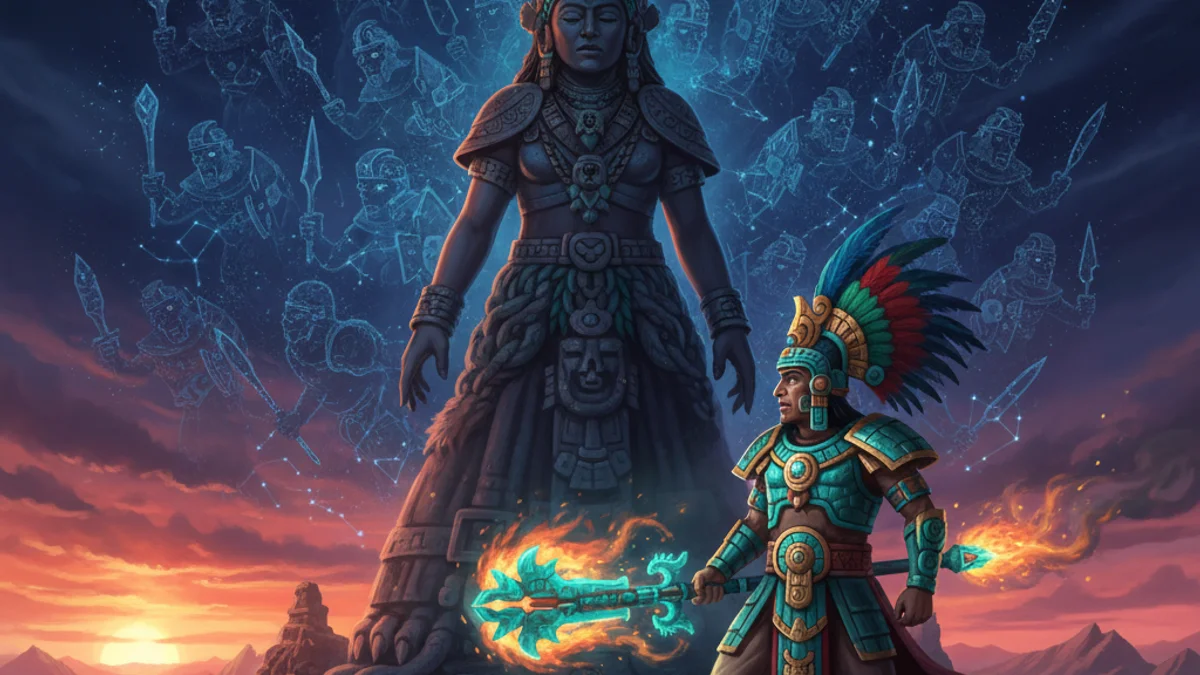
Coatlicue, the earth goddess, was sweeping on Mount Coatepec when a bundle of brilliant feathers fell from the sky. She placed them in her bosom, but when she looked for them later, they had vanished, and she discovered she was pregnant. Her daughter, Coyolxauhqui, and her four hundred sons, the Centzon Huitznahua, were incensed by what they perceived as their mother's shame. They donned their armor and marched toward the mountain to slay her. Inside the womb, Huitzilopochtli spoke to his mother, urging her not to fear. As the vengeful siblings reached the summit, Huitzilopochtli was born fully grown and armored, his face painted blue and his limbs adorned with feathers. Wielding the Xiuhcoatl, a serpent of living fire, he struck down his sister and scattered his brothers across the sky. He emerged not just as a son, but as the invincible sun and the protector of the Aztec people.
True power and protection often emerge in the moments of our greatest vulnerability, proving that destiny cannot be extinguished by jealousy.
Questions about this story
What is the moral of Huitzilopochtli's Birth?
The moral is that destiny and divine protection will prevail even when faced with overwhelming betrayal and odds. It highlights the role of a protector rising during a time of great need.
Who is Huitzilopochtli in Aztec mythology?
Huitzilopochtli is the Aztec god of war, the sun, and human sacrifice, serving as the patron deity of the city of Tenochtitlan. He is often depicted with a hummingbird helmet or feathers.
Who was Huitzilopochtli's mother?
His mother was Coatlicue, the earth goddess known as 'She of the Serpent Skirt.' She is a primordial creator deity who represents both life and death.
What is the Xiuhcoatl?
The Xiuhcoatl is the 'Fire Serpent,' a mythical weapon wielded by Huitzilopochtli. It represents the rays of the sun and was used to defeat his sister, Coyolxauhqui.
Advertisement



Good night.
