
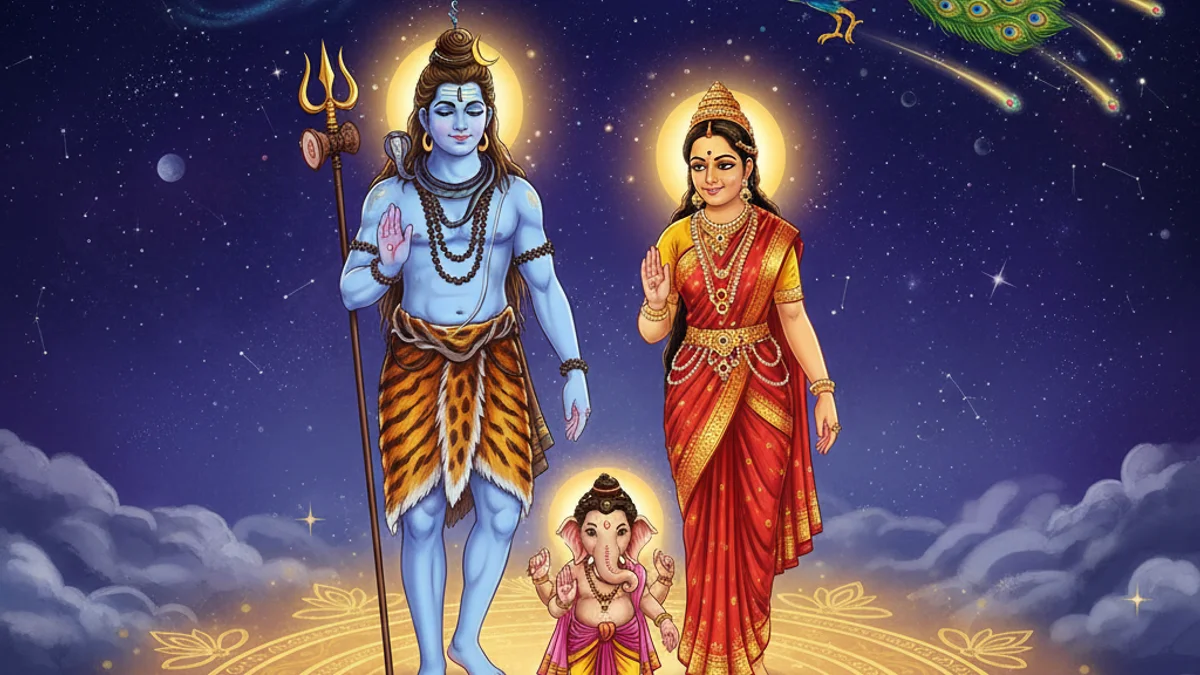
Lord Shiva and Goddess Parvati once held a golden mango, the fruit of supreme knowledge. Both their sons, Ganesha and Kartikeya, wanted the prize. To settle the matter, Shiva proposed a challenge: the first to circle the world three times would win the fruit. Kartikeya immediately mounted his swift peacock and sped across the oceans and continents. Ganesha, possessing a heavy body and a slow-moving mouse as his mount, knew he could not win through speed. He paused, reflected, and then walked around his parents three times with deep devotion. When Kartikeya returned exhausted from his journey, he found Ganesha already being crowned the winner. Ganesha explained that for a child, his parents represent the entire universe. Impressed by his profound wisdom and devotion, Shiva and Parvati happily handed him the divine mango.
Wisdom and devotion are more powerful than physical strength. Recognizing the value of one's roots and parents is the ultimate form of intelligence.
Advertisement
Questions about this story
What is the moral of Ganesha and the Race?
The story teaches that wisdom and perspective are more important than brute force or speed. It also highlights that for a child, parents are the most significant part of their world.
Who participated in the race around the world?
The race was between the two sons of Shiva and Parvati: the elephant-headed Ganesha and the warrior-god Kartikeya. While Kartikeya relied on physical speed, Ganesha used his intellect to win.
What was the prize for winning the race?
The prize was a divine golden mango, often referred to as the Fruit of Knowledge or 'Jnana Palam.' It was said to contain the essence of all wisdom in the universe.
Why did Ganesha circle his parents instead of the world?
Ganesha believed that his parents, Shiva and Parvati, were the creators and the very essence of the universe. By circling them, he symbolically circled the entire world according to ancient scriptures.
Advertisement
