
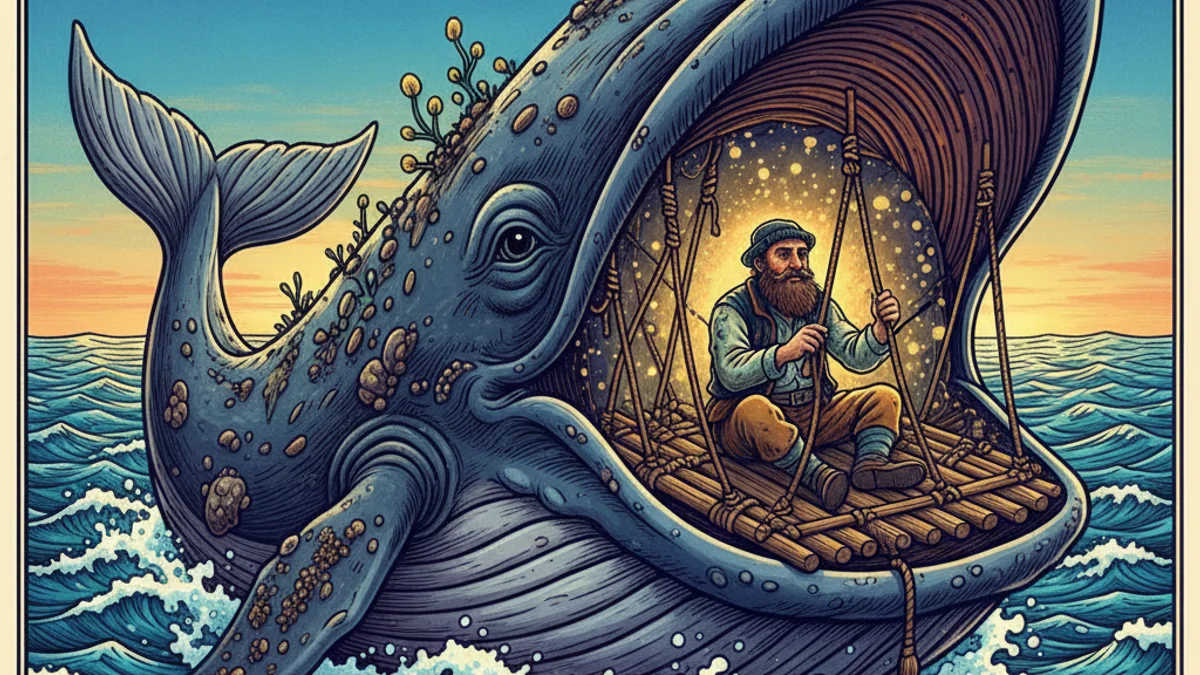
In the sea of long ago, there was a Whale who ate every fish he could find until only one small, clever 'Stute Fish remained. To save itself, the fish told the hungry Whale about a delicious morsel: a shipwrecked Mariner sitting on a raft in the middle of the ocean. The Whale swam north and swallowed the Mariner, his raft, and even his blue canvas breeches in one gulp. However, the Mariner was a man of 'infinite-resource-and-sagacity.' Once inside the Whale's dark belly, he jumped, danced, and bumped around so much that the Whale developed a terrible hiccuping ache. Desperate for relief, the Whale agreed to take the Mariner home to the white cliffs of Albion. Before stepping out, the Mariner used his wooden raft and his suspenders to wedge a strong wooden grating into the Whale’s throat. From that day on, the Whale could never swallow anything larger than a tiny fish, which is why whales today only eat small things through their baleen.
Intelligence and resourcefulness are more powerful than brute strength and a large appetite.
Questions about this story
What is the moral of How the Whale Got Its Throat?
The story teaches that wit and resourcefulness can overcome even the most daunting physical challenges. The Mariner uses his intelligence to save himself from a situation where strength alone would have failed.
Who wrote How the Whale Got Its Throat?
The story was written by Rudyard Kipling as part of his famous 1902 collection titled 'Just So Stories.' These tales were originally told to his daughter, Josephine.
Why did the Whale swallow the Mariner?
The Whale had eaten all the other fish in the sea except for one clever 'Stute Fish. The 'Stute Fish tricked the Whale into eating the Mariner to save itself from being eaten.
How did the Mariner escape the Whale's belly?
The Mariner danced and jumped inside the Whale's stomach to cause discomfort. He refused to leave until the Whale took him home to the shores of England.
Advertisement


Good night.
