
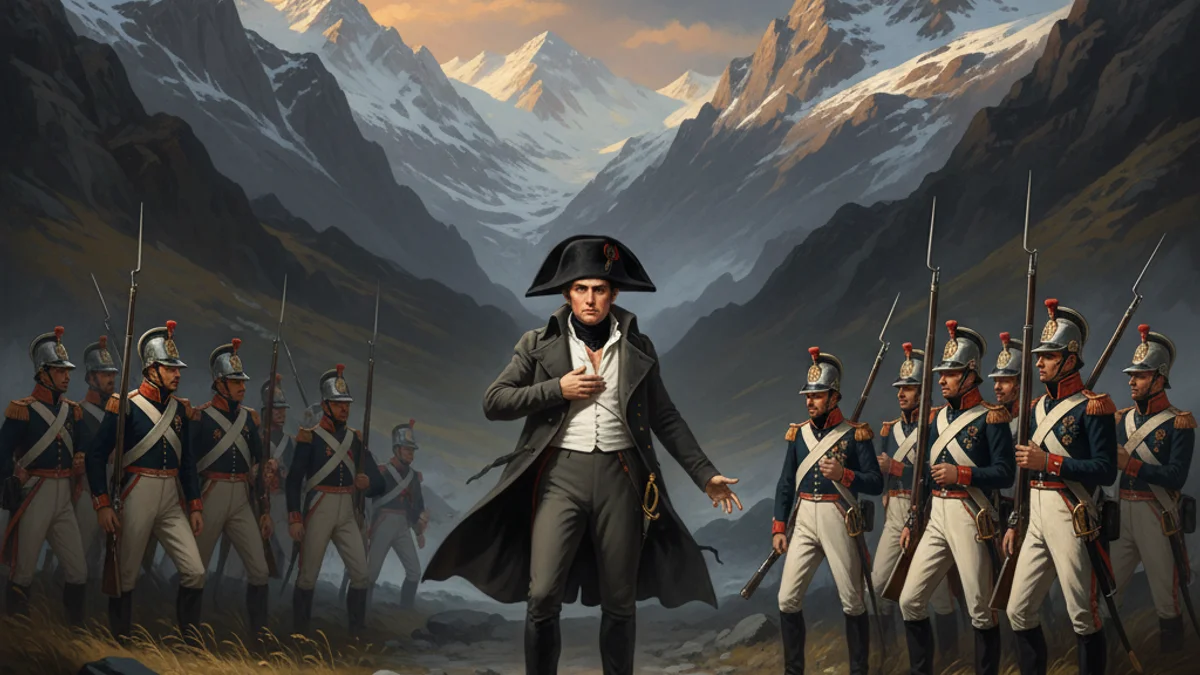
In 1815, the exiled Napoleon Bonaparte escaped the island of Elba with a small band of loyalists, landing on the shores of France to reclaim his empire. As he marched toward Paris, King Louis XVIII dispatched the 5th Regiment of the Line to intercept and arrest him near Grenoble. The two forces met in a narrow pass at Laffrey. The royalist soldiers stood with muskets leveled, ready to fire upon the man they once followed. Without drawing a weapon, Napoleon stepped forward alone. He opened his signature grey overcoat, baring his chest to the line of rifles, and cried out, 'Soldiers of the 5th, I am your Emperor. Know me! If there is one among you who would kill his Emperor, here I am.' Silence hung in the air for a heartbeat before the soldiers broke ranks, weeping and shouting, 'Vive l'Empereur!' Instead of a battle, there was a reunion. Napoleon's sheer charisma and the deep bond he shared with his troops allowed him to retake France without firing a single shot.
True leadership is not found in titles or force, but in the courage to stand before others and the legacy of the bonds one has built.
Questions about this story
What is the moral of Napoleon's Return from Elba?
The story teaches that true leadership stems from personal courage and the deep emotional connection a leader shares with their followers. It shows that presence and character can be more powerful than physical force.
How did Napoleon escape from Elba?
In February 1815, taking advantage of the temporary absence of British and French guard ships, Napoleon slipped away on the brig Inconstant with about 1,000 supporters.
What happened at the meeting with the 5th Regiment?
Napoleon confronted the soldiers sent to arrest him by baring his chest and inviting them to shoot their Emperor; instead, the soldiers joined him in his march to Paris.
Who was the king during Napoleon's return?
King Louis XVIII was the reigning monarch of the restored Bourbon dynasty, who eventually fled Paris as Napoleon's popularity grew during his return.
Advertisement
Good night.
