
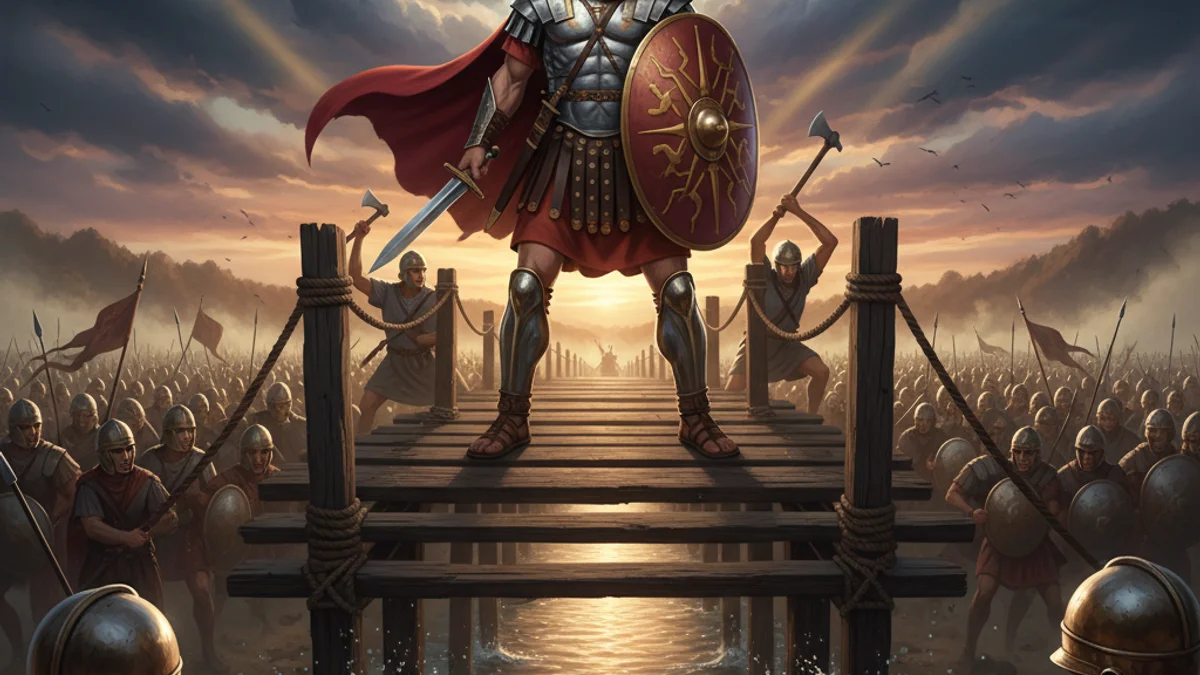
In the early days of the Roman Republic, the city faced a dire threat from the Etruscan king Lars Porsena, who marched with a massive army to restore the exiled tyrant Tarquinius Superbus to the throne. As the Etruscans reached the Janiculum hill, the Romans fled in terror toward the Sublician Bridge, the only path across the Tiber into the heart of Rome. Seeing the panic, a brave officer named Horatius Cocles realized that if the enemy crossed the bridge, the city was lost. He called out to his fellow citizens to destroy the bridge behind him while he held the far end. Two noble comrades, Spurius Lartius and Titus Herminius, stood by his side. Together, the three men faced the entire Etruscan vanguard on the narrow passage. As the bridge groaned and began to crack under the Roman axes, Horatius ordered his companions to retreat to safety. Alone, he stood against the hail of spears and the weight of the Etruscan host. When the bridge finally crashed into the Tiber, Horatius cried out to the river god for protection and plunged, fully armored, into the churning waters. Despite his wounds and the weight of his gear, he swam through the current and reached the Roman shore safely. His selfless bravery saved the Republic, and the grateful citizens erected a statue in his honor.
True heroism lies in the willingness to sacrifice oneself for the safety and liberty of one's community.
Questions about this story
What is the moral of Horatius at the Bridge?
The moral is that individual courage and self-sacrifice are essential for the survival of a free society. It highlights that one person's bravery can inspire an entire nation to overcome overwhelming odds.
Was Horatius Cocles a real person?
Horatius is considered a semi-legendary figure. While the conflict between Rome and the Etruscans was real, his specific feat at the bridge likely blends historical fact with Roman myth-making to celebrate civic virtue.
Who was the enemy in the story of Horatius?
The enemy was the Etruscan army led by King Lars Porsena of Clusium. They were attempting to capture Rome to reinstate the deposed Roman King, Tarquinius Superbus.
Did Horatius survive the jump into the Tiber?
In the most famous version by the historian Livy, Horatius survives the swim and is greeted as a hero. However, some earlier traditions suggest he may have perished in the river after completing his duty.
Advertisement


Good night.
