
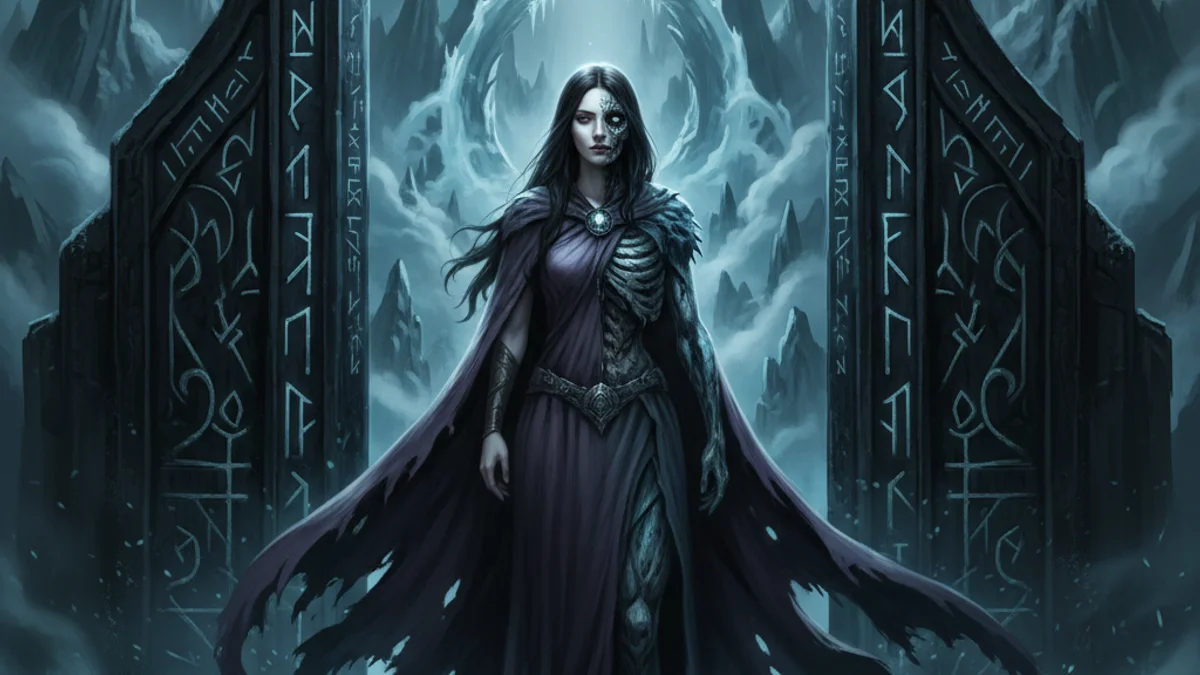
Hel was born of a forbidden union between the trickster god Loki and the giantess Angrboda. Along with her brothers, the wolf Fenrir and the serpent Jörmungandr, she was prophesied to bring ruin to the Aesir. Recognizing the danger, Odin cast her deep into the mists of Niflheim. Unlike her brothers, who were bound or banished to the sea, Hel was given sovereignty over the nine worlds of the dead. She appeared as a haunting duality: one half of her body was that of a vibrant, living woman, while the other was the blue-tinged, decaying flesh of a corpse. In her cold hall, Eljudnir, she received those who died of 'straw death'—sickness and old age—rather than the glory of battle. She reigned with an indifferent justice, serving as a reminder that while the gods feasted in Asgard, the silent grave claimed the majority of existence. Even when the beloved god Baldur died, Hel refused to release him unless every living thing wept, proving that even the High One, Odin, could not command the finality of her realm.
Death is an inescapable and impartial force that treats all souls with the same cold indifference, regardless of their status in life.
Questions about this story
What is the moral of Hel Ruler of the Dead?
The story teaches that death is an inevitable part of the natural order that even gods cannot bypass. It emphasizes that every life, no matter how grand, eventually meets a silent and impartial end.
Who are the parents of Hel in Norse mythology?
Hel is the daughter of the trickster god Loki and the giantess Angrboda. She is the sister of the Great Wolf Fenrir and the Midgard Serpent Jörmungandr.
What does Hel look like?
Hel is traditionally described as a half-living, half-dead being. One side of her body is depicted as a beautiful, living woman, while the other side is the rotting or blue-black flesh of a corpse.
Who goes to Hel's realm instead of Valhalla?
While Valhalla is for those who die heroically in battle, Hel's realm is for those who die of 'straw death,' which includes old age, illness, or non-combat circumstances.
Advertisement
Good night.
