
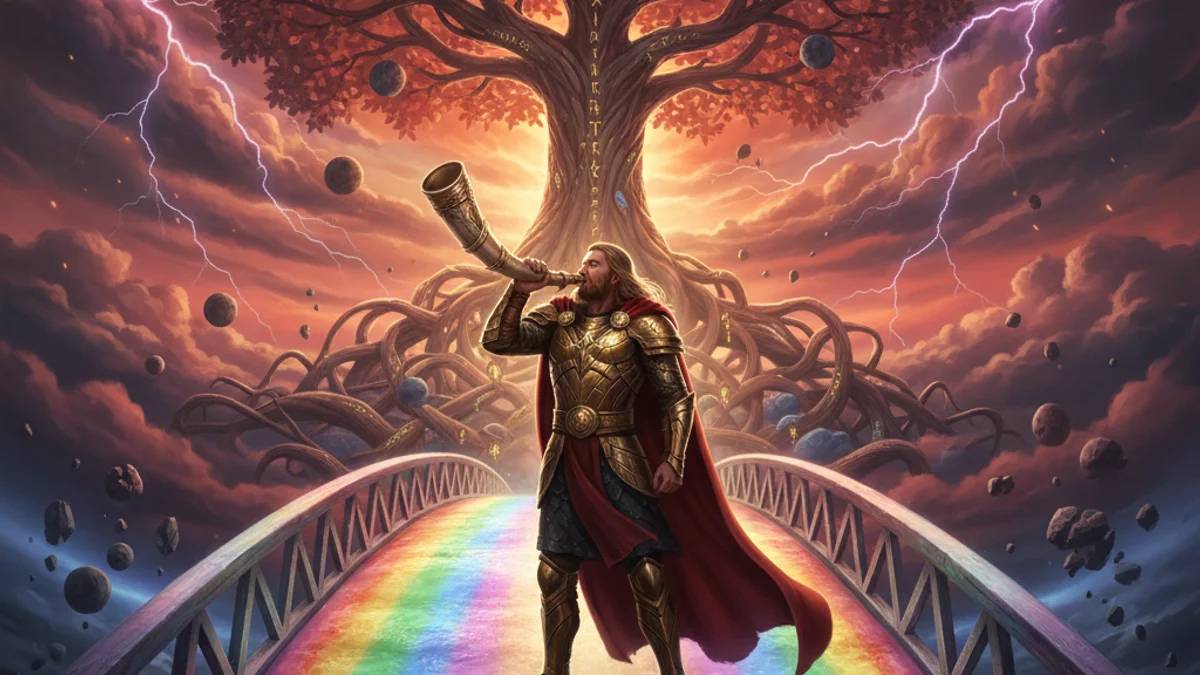
Heimdall, the white god and son of nine mothers, stands as the eternal watchman of Asgard. Perched upon the Bifrost bridge, his senses are so sharp he can hear grass growing in Midgard and see for a hundred leagues in the dark. Beside him rests the Gjallarhorn, the 'Yelling Horn,' whose sound can be heard throughout all nine worlds. For eons, Heimdall remains a silent sentinel, watching for the flickering shadows of giants. But prophecy speaks of a day when the sun will darken and the Great Winter will freeze the hearts of men. In that hour of doom, when the enemies of the gods gather at the fields of Vigrid, Heimdall will finally lift the golden horn to his lips. Its singular, earth-shaking blast will serve as the final warning, waking the gods from their slumber and summoning the Einherjar from Valhalla to meet their destiny. The sound of Heimdall's Horn is not just a call to war, but the first note in the symphony of the world's destruction and rebirth.
Vigilance and the fulfillment of one's duty are the ultimate virtues, even when faced with an inevitable end.
Questions about this story
What is the moral of Heimdall's Horn?
The story emphasizes that true honor lies in remaining steadfast and vigilant in one's responsibilities. Even if the outcome is predetermined, performing one's duty with courage is the mark of a hero.
What is the name of Heimdall's horn?
The horn is called Gjallarhorn, which translates to 'the yelling horn' or 'the loud-sounding horn' in Old Norse.
Where is the Gjallarhorn kept when not in use?
According to the prose Edda, the horn is often said to be hidden beneath the roots of the world tree Yggdrasil, specifically near Mimir's well.
What specifically triggers the blowing of the horn?
Heimdall blows the horn when he sees the giants and the forces of chaos approaching Asgard to begin the final battle of Ragnarok.
Advertisement

Good night.
