
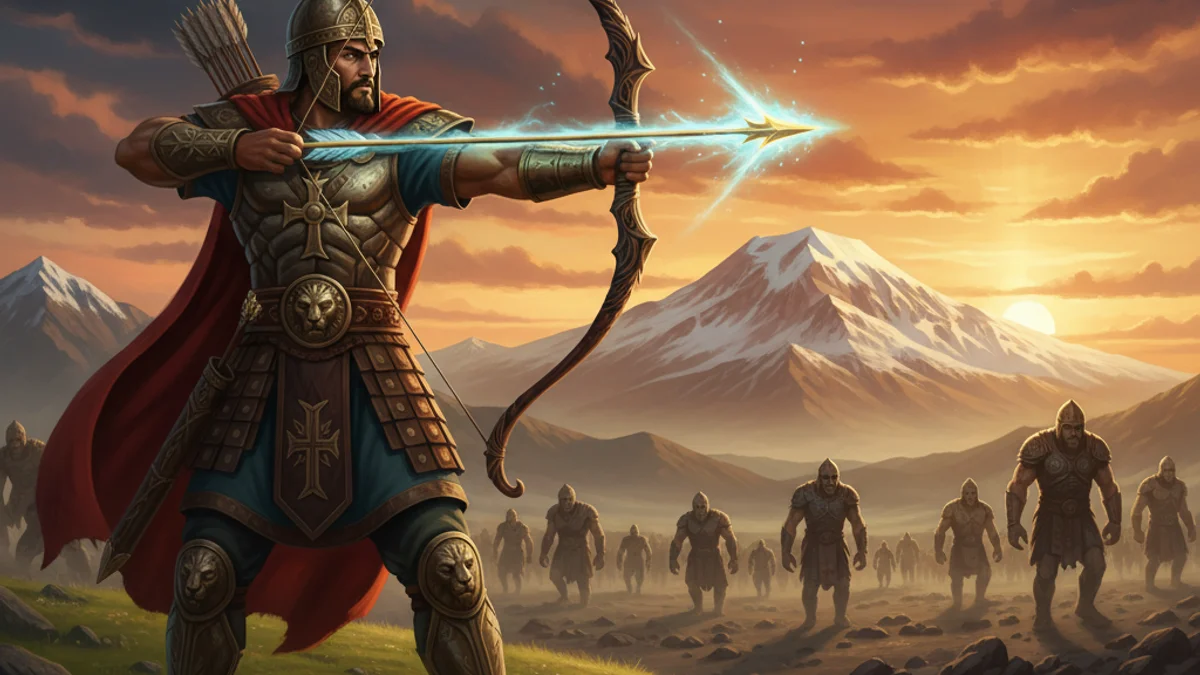
In the ancient days following the Great Flood, a noble giant named Hayk lived in the shadow of the Tower of Babel. While others bowed to the tyrannical Bel, a Babylonian king who demanded worship as a god, Hayk refused to surrender his dignity. Gathering his family and three hundred followers, Hayk migrated north toward the rugged highlands near Mount Ararat. Furious at this defiance, Bel raised a massive army and pursued him. The two forces met in the valley of Hayots Dzor. Though outnumbered, Hayk was a master archer. He stepped forward and drew his massive longbow, letting fly a three-pronged arrow that pierced Bel’s breastplate, pinning the tyrant to the earth. The Babylonian army fled in terror. Hayk established the land of Hayastan, becoming the forefather of the Armenian people and proving that the spirit of liberty is more powerful than the might of kings.
True leadership is defined by the courage to resist tyranny and the commitment to lead one's people toward freedom and self-determination.
Questions about this story
What is the moral of Hayk the Archer?
The story emphasizes that freedom is a fundamental right worth fighting for against any tyrant. It teaches that one brave leader can inspire an entire nation to claim their independence through courage and skill.
Who was Bel in Armenian mythology?
Bel, often associated with the biblical Nimrod, was a tyrannical king of Babylon who demanded to be worshipped as a god. He represents the force of oppression that Hayk had to overcome to save his people.
Where did the battle between Hayk and Bel take place?
The legendary battle occurred in a region near Lake Van, specifically in a valley that would later be named Hayots Dzor, which translates to 'The Valley of the Armenians.'
Is Hayk the Archer a real historical figure?
While Hayk is a mythological figure, he is considered the legendary patriarch and founder of the Armenian nation. For Armenians, he symbolizes the historical struggle for sovereignty and cultural identity.
Advertisement


Good night.
