
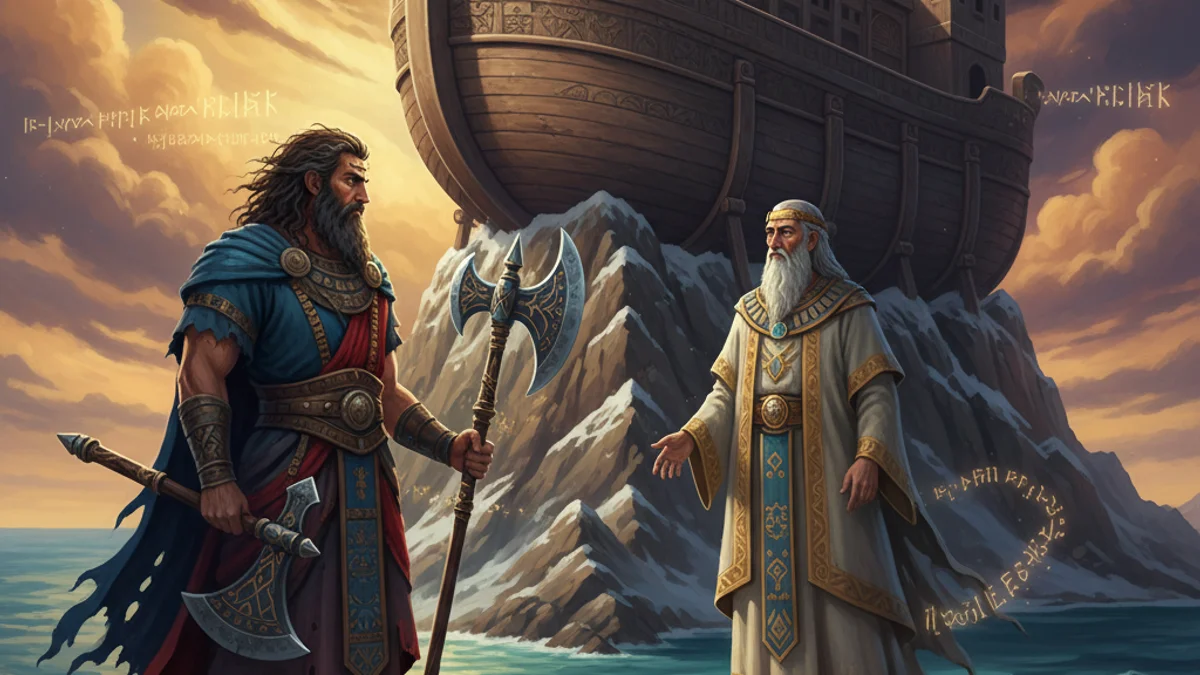
Devastated by the death of his friend Enkidu, King Gilgamesh of Uruk abandons his throne to seek the secret of eternal life. He travels to the edges of the world, crossing the treacherous Waters of Death to find Utnapishtim, the only mortal granted immortality by the gods. Utnapishtim recounts how he survived the Great Flood by building a massive ark, after which the god Enlil bestowed eternal life upon him and his wife. To prove Gilgamesh is worthy, Utnapishtim challenges him to stay awake for six days and seven nights. Gilgamesh fails instantly, falling into a deep sleep. Seeing his despair, Utnapishtim’s wife convinces her husband to reveal a secret: a prickly plant at the bottom of the sea that restores youth. Gilgamesh retrieves it, but while he bathes on his journey home, a snake steals the plant and sheds its skin, gaining the youth Gilgamesh sought. Returning to Uruk empty-handed, Gilgamesh finally understands that immortality is not for man, but his legacy lives on through the mighty walls he built.
Mortality is the inevitable fate of humankind, and true immortality is found not in living forever, but in the great works and legacy one leaves behind.
Questions about this story
What is the moral of Gilgamesh and Utnapishtim?
The story teaches that physical immortality is impossible for humans. Instead, one should focus on the quality of their life and the lasting legacy they leave through their achievements.
Why did Gilgamesh seek out Utnapishtim?
After his close friend Enkidu died, Gilgamesh became terrified of his own death. He sought Utnapishtim to learn how to escape mortality and live forever like the gods.
What was the test Utnapishtim gave to Gilgamesh?
Utnapishtim challenged Gilgamesh to stay awake for six days and seven nights. Gilgamesh failed immediately, showing that if he could not even defeat sleep, he could never defeat death.
How is Utnapishtim's flood story similar to Noah's Ark?
Both stories feature a hero warned by a deity of a coming flood, the construction of a large boat to save family and animals, and the use of birds to search for dry land.
Advertisement

Good night.
