
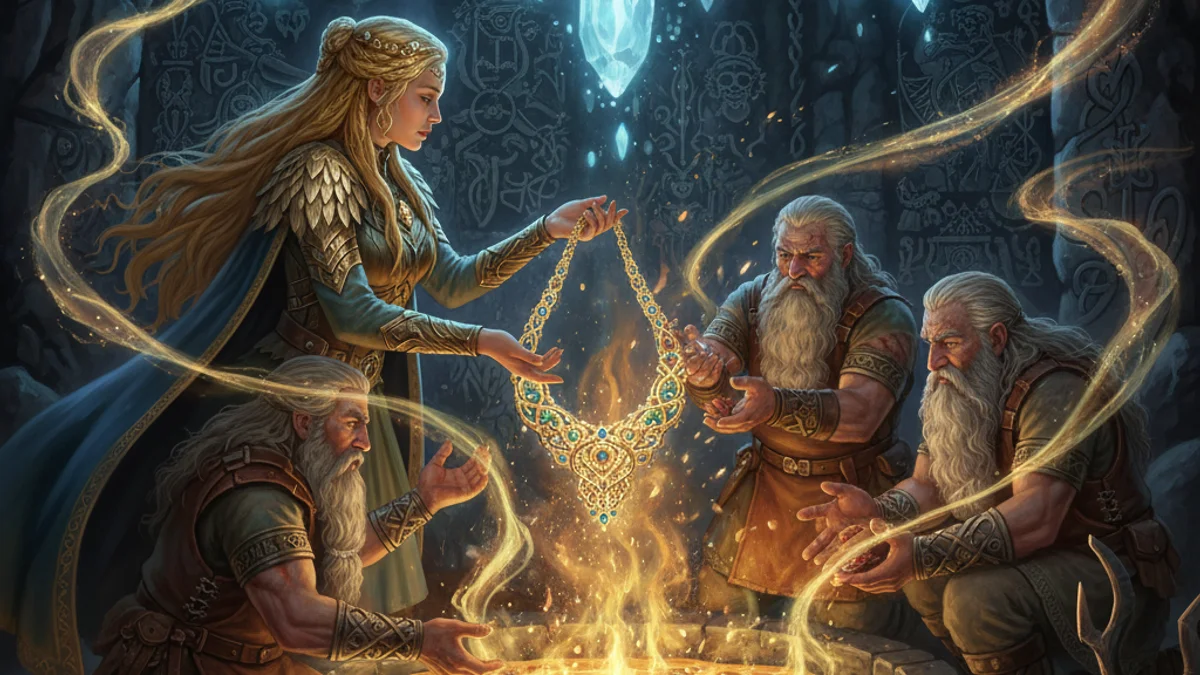
Freya, the radiant goddess of love, once wandered into the subterranean realm of the dwarves. Deep within a cavern, she discovered four master smiths—Alfrigg, Berling, Dvalinn, and Grer—fashioning a necklace of such exquisite gold that it outshone the sun. This was the Brisingamen. Consumed by desire, Freya offered gold and silver for the treasure, but the dwarves refused her riches. They demanded a different price: she must spend one night with each of them. To possess the necklace, Freya agreed, sacrificing her pride for the golden prize. When she returned to Asgard, the trickster Loki discovered her secret and informed Odin. Enraged by her conduct, Odin commanded Loki to steal the necklace. Loki transformed into a flea, bit the sleeping goddess to make her turn, and unclasped the Brisingamen. Upon waking to find her treasure gone, Freya confronted Odin. He returned the necklace only on the condition that she incite a perpetual war between two kings, proving that even the greatest beauty carries a devastating cost.
Unbridled desire and the pursuit of material beauty can lead to the loss of one's dignity and cause suffering for others.
Questions about this story
What is the moral of Freya and the Brisingamen?
The moral is that greed and vanity often come with a steep price that affects not just the individual, but the world around them. Freya’s desire for the necklace led to her humiliation and a cycle of endless war.
Who made the Brisingamen necklace?
The necklace was crafted by four dwarves named Alfrigg, Berling, Dvalinn, and Grer. They were master smiths who valued Freya's attention more than any amount of gold or silver she could offer.
How did Loki steal the Brisingamen?
Loki transformed himself into a flea to sneak into Freya's locked bedroom. He bit her cheek while she slept, causing her to turn over so he could reach the clasp of the necklace and steal it.
What was the price Freya paid for the necklace?
Freya paid a double price: first, she spent a night with each of the four dwarves to acquire it. Later, she was forced by Odin to instigate a war between two kings to win it back after it was stolen.
Advertisement
Teach next
Good night.
