
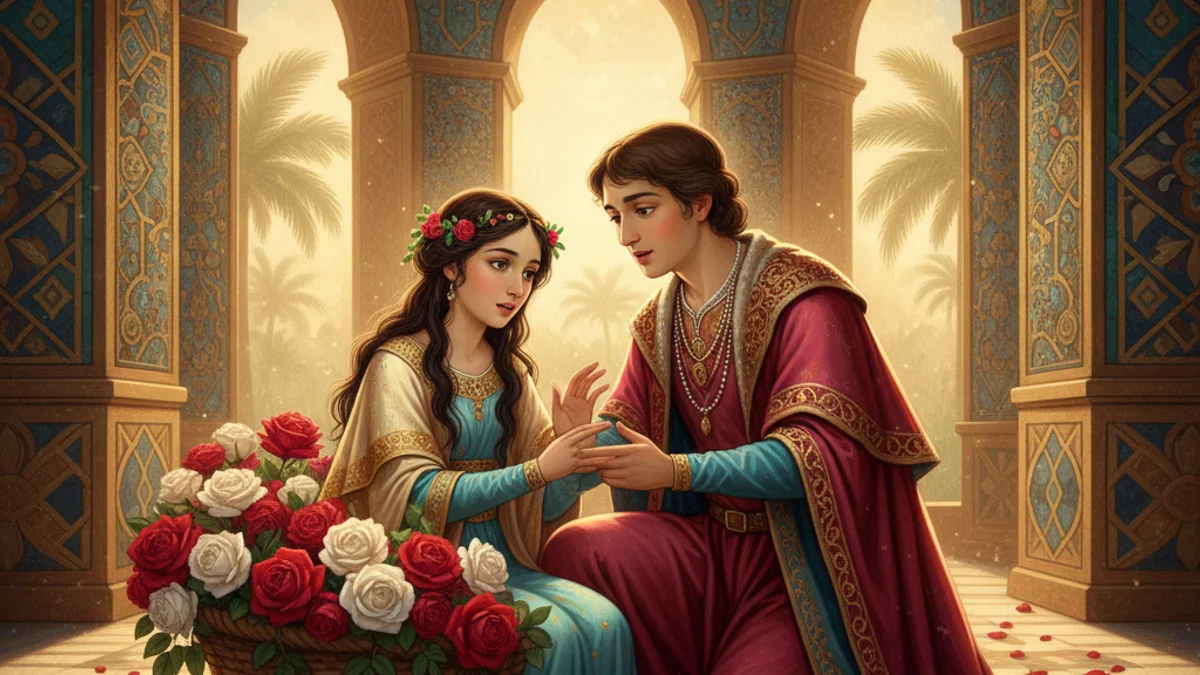
Floire, the son of a Muslim king, and Blanchefleur, the daughter of a captured Christian lady, were born on the same day and raised together in the Spanish court. Their childhood bond blossomed into a deep, inseparable love that defied their different social and religious standings. Fearing this union, Floire’s father secretly sold Blanchefleur to merchants, who carried her away to the distant city of Babylon to live in the Emir’s harem. To cover his tracks, the King built a magnificent tomb and told Floire his beloved had died. Distraught, Floire attempted to take his own life until his mother revealed the truth. The young prince embarked on a perilous journey across the sea, disguised as a merchant, to rescue her. Through wit and the help of a sympathetic gatekeeper, Floire was smuggled into the Emir's high tower hidden inside a large basket of flowers. Though the lovers were eventually discovered and sentenced to be burned at the stake, their courage and willingness to die for one another so moved the Emir that he pardoned them. Floire and Blanchefleur were married in a grand ceremony and returned home to rule their kingdom with compassion and tolerance.
True love knows no boundaries of religion or distance and can melt even the coldest of hearts through sacrifice.
Questions about this story
What is the moral of Floire and Blanchefleur?
The moral is that love is a universal force that transcends religious, cultural, and social barriers. It emphasizes that sincere devotion and the spirit of self-sacrifice can overcome even the most daunting obstacles and change the minds of powerful rulers.
What is the origin of the story of Floire and Blanchefleur?
The story is a popular 12th-century French 'roman d'idyle.' It likely has roots in earlier folk traditions and served as a bridge between Western European courtly love and Eastern narrative themes common during the Crusades.
Are Floire and Blanchefleur based on real people?
While the story is legendary and fictional, some medieval traditions link the couple to the lineage of Charlemagne, claiming they were the parents of Bertha Broadfoot. However, there is no historical evidence to support their existence.
What does the name 'Floire and Blanchefleur' mean?
Their names are symbolic of flowers, which play a central role in the story's imagery. 'Floire' is associated with flowering or blossoming, while 'Blanchefleur' means 'white flower,' representing her purity and Christian faith.
Advertisement

Good night.
