
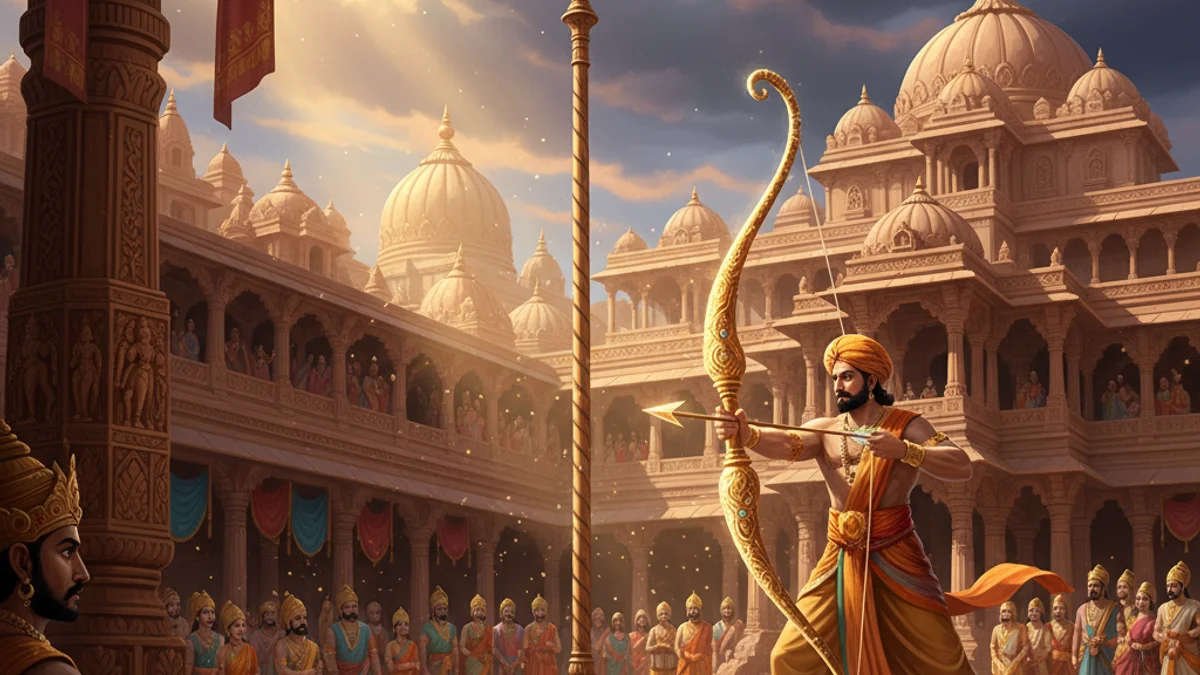
King Drupada of Panchala organized a grand swayamvara for his daughter, Draupadi, born of fire. The challenge was nearly impossible: a suitor had to lift a massive celestial bow, string it, and shoot five arrows through the eye of a rotating wooden fish high above, looking only at its reflection in a pool of water below. Mighty kings and princes from across Bharatvarsha failed, humiliated by the bow's weight. When Karna stepped forward, Draupadi famously refused him due to his perceived lineage. Just as hope seemed lost, a young Brahmin stepped from the crowd. It was Arjuna, disguised during the Pandavas' exile. With divine focus, he lifted the bow, drew the string, and pierced the fish's eye in one fluid motion. Though the royalty protested a Brahmin winning a princess, Krishna intervened, recognizing the divine destiny at play. Draupadi garlanded Arjuna, and the Pandavas returned to their mother, Kunti. Misunderstanding their arrival with 'alms,' Kunti commanded them to share whatever they had brought, leading to Draupadi becoming the wife of all five brothers.
True merit and focused concentration are superior to inherited status or sheer physical strength.
Questions about this story
What is the moral of Draupadi's Swayamvara?
The story teaches that skill, discipline, and concentration (Ekagrata) are the true measures of a person's worth. It also shows that destiny unfolds in mysterious ways, often defying social expectations.
What was the challenge in the Swayamvara?
Suitors had to string a heavy divine bow and shoot five arrows through the eye of a revolving fish. The catch was that they could only look at the fish's reflection in a bowl of water.
Why was Arjuna in disguise during the event?
The Pandavas were living in hiding after the attempt on their lives at the Palace of Lac. They attended the Swayamvara disguised as poor Brahmins to avoid detection by the Kauravas.
Who was the only suitor besides Arjuna capable of the feat?
Karna was traditionally considered capable of winning the challenge. However, in many versions, he was either disqualified by Draupadi or failed by a hair's breadth depending on the regional retelling.
Advertisement
Good night.
