
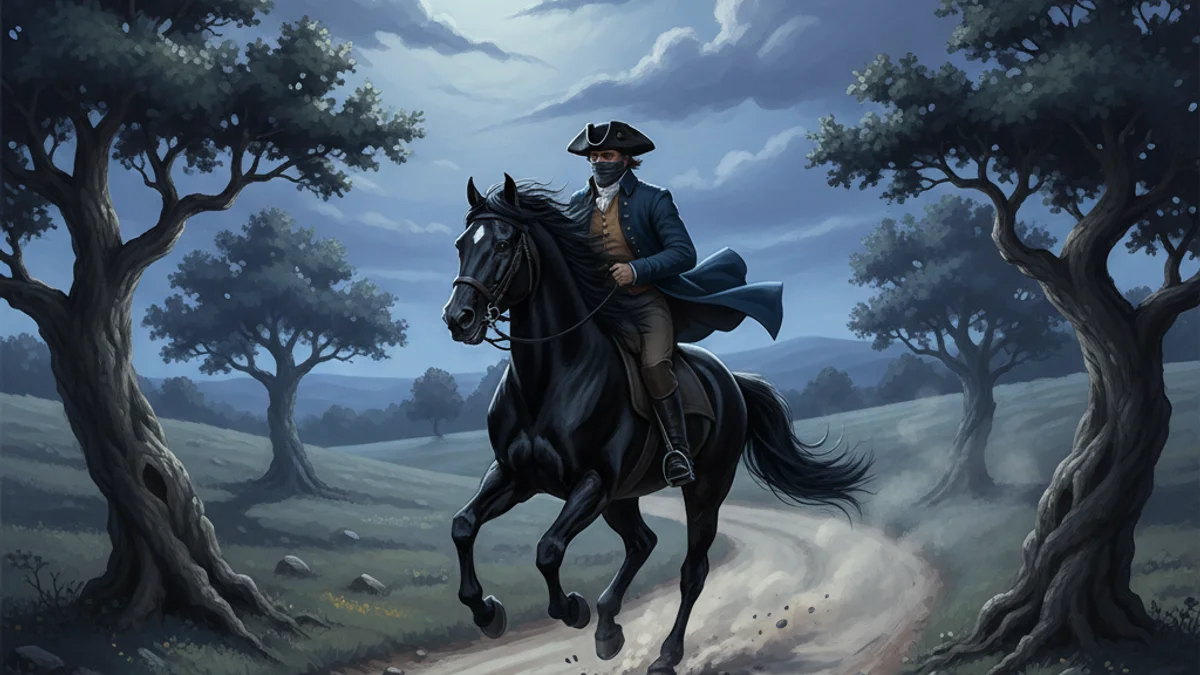
In the annals of English folklore, few tales match the desperate speed of Dick Turpin's Ride. After a botched robbery and a fatal scuffle in London, the notorious highwayman needed an alibi that defied the laws of nature. Mounting his faithful mare, Black Bess, Turpin set out on a grueling two-hundred-mile journey toward York. Through the dark, misty night, the thundering of hooves echoed across the Great North Road. They galloped through villages and across desolate heaths, the horse straining every sinew for her master. By sunrise, they reached the gates of York, establishing an impossible alibi that stunned his pursuers. However, the victory was hollow; as the city spires came into view, the exhausted Black Bess collapsed and died, her heart broken by the impossible pace. Though Turpin escaped the immediate noose, he lost his most loyal companion to his own desperation.
Reckless ambition and the pursuit of self-preservation can cost us what we value most, proving that legend often comes at a tragic price.
Questions about this story
What is the moral of Dick Turpin's Ride?
The story illustrates that legendary feats often carry a high cost, specifically the sacrifice of the innocent. It warns that running from one's crimes can lead to the destruction of what is truly valuable.
Did Dick Turpin really ride from London to York in one night?
Historically, the ride is considered a myth. While Dick Turpin was a real highwayman, the story of the 200-mile ride was popularized by William Harrison Ainsworth in his 1834 novel, Rookwood.
Who was Black Bess in the story?
Black Bess was Dick Turpin's legendary horse, celebrated for her stamina and loyalty. In the legend, she is the tragic hero who gives her life to save her master from the gallows.
How long was the journey from London to York?
The journey is roughly 200 miles long. Achieving this distance in a single night on horseback was considered an impossible feat, which is why it served as the perfect alibi in the legend.
Advertisement


Good night.
