
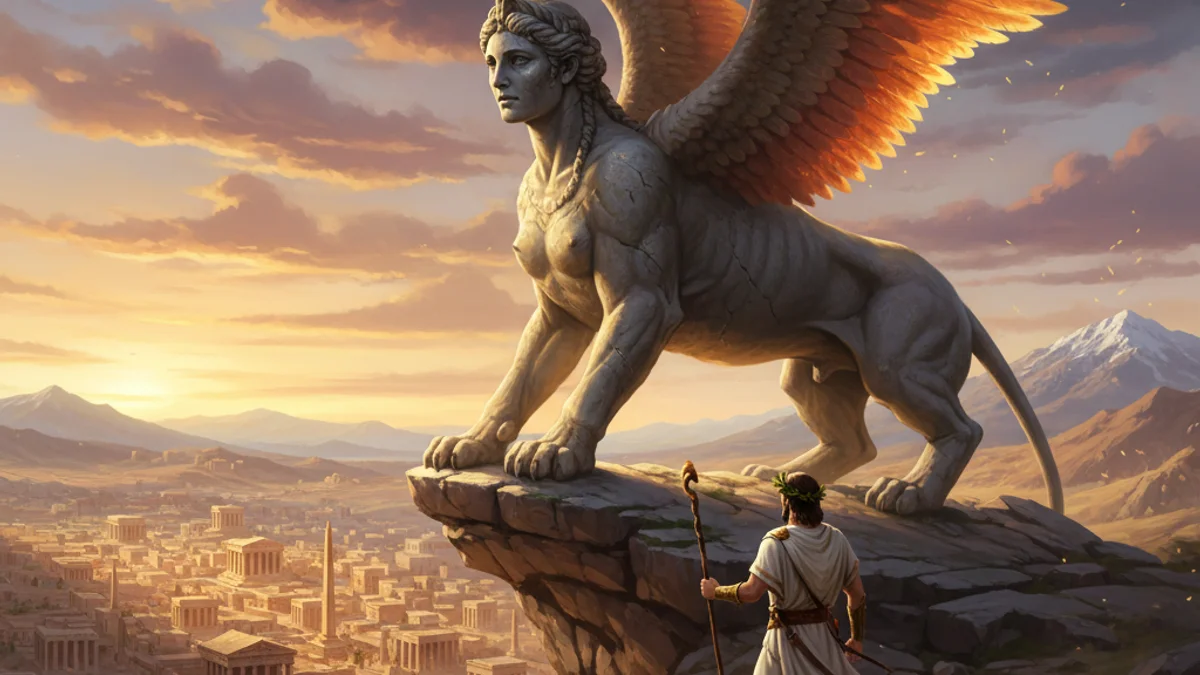
The city of Thebes was under the shadow of a terrifying creature: the Sphinx, a monster with the body of a lion, the wings of an eagle, and the head of a woman. Perched on a rocky outcrop outside the city gates, she blocked the path of all travelers, posing a single, cryptic riddle. Those who failed to answer were devoured on the spot. Many had perished, and the city was in despair until a traveler named Oedipus arrived. The Sphinx looked down at him and spoke: 'What walks on four legs in the morning, two legs in the afternoon, and three legs in the evening?' Without hesitation, Oedipus replied, 'Man. As an infant, he crawls on all fours; as an adult, he walks upright on two; and in old age, he leans on a staff for a third leg.' Defeated by the human's intellect, the Sphinx threw herself from the cliff to her death, and Oedipus was hailed as the savior of Thebes.
Intellectual clarity and the ability to understand the human condition are more powerful than brute strength.
Questions about this story
What is the moral of The Sphinx's Riddle?
The story suggests that wisdom and the power of the human mind can overcome even the most formidable and monstrous challenges. It highlights that self-knowledge is the ultimate key to survival.
What was the riddle of the Sphinx?
The riddle asked what creature walks on four legs in the morning, two in the afternoon, and three in the evening. This refers to the stages of human life: infancy, adulthood, and old age.
Who defeated the Sphinx in Greek mythology?
Oedipus, a wandering prince, was the only one capable of solving the riddle. His victory led to his appointment as the King of Thebes.
What happened to the Sphinx after the riddle was solved?
According to most versions of the myth, the Sphinx was so distraught by her defeat that she threw herself from a high cliff and died. This liberated the city of Thebes from her terror.
Advertisement

Good night.
