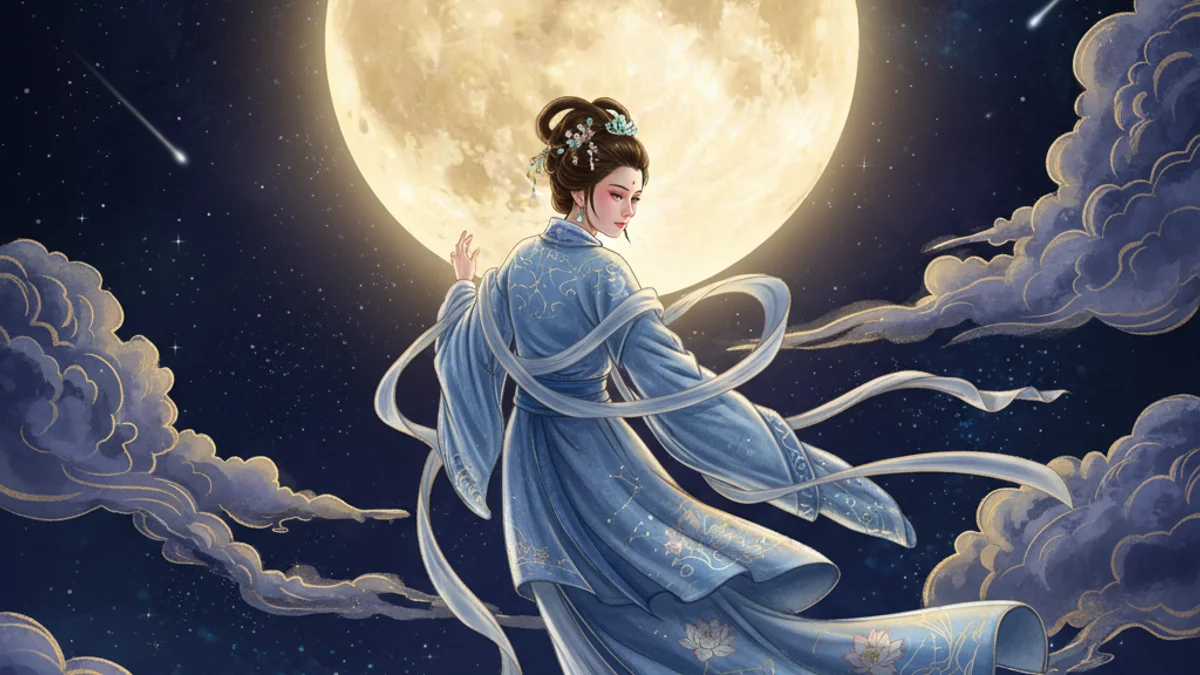
Long ago, ten suns rose in the sky simultaneously, scorching the earth and bringing misery to mankind. The Great Archer Hou Yi ascended to the top of Kunlun Mountain and shot down nine of the suns, saving humanity. As a reward, the Queen Mother of the West gave him an elixir of immortality. Hou Yi, deeply in love with his wife Chang'e, did not want to leave her, so he asked her to hide the elixir. However, a greedy apprentice named Peng Meng broke into their home while Hou Yi was hunting, demanding the potion. To prevent it from falling into evil hands, Chang'e drank the elixir herself. She felt her body grow light and floated out the window toward the heavens. Choosing to stay as close to her husband as possible, she landed on the moon. Hou Yi, devastated, began leaving her favorite cakes and fruits in the garden every year under the full moon, a tradition that endures today.
True love and self-sacrifice transcend the physical world, showing that protecting what is right often requires a heavy personal cost.
Questions about this story
What is the moral of Chang'e Flies to the Moon?
The story teaches that sacrifice for the greater good and devotion to one's loved ones are timeless virtues. It highlights how love can endure even across the vast distance between earth and the heavens.
Why did Chang'e drink the elixir of immortality?
Chang'e drank the elixir to prevent the villainous Peng Meng from stealing it and becoming an immortal tyrant. It was a desperate act of protection to keep the powerful potion out of the wrong hands.
How is this story connected to the Mid-Autumn Festival?
This legend is the origin of the Mid-Autumn Festival, where families gather to watch the moon and eat mooncakes. It commemorates Chang'e's ascent and Hou Yi's longing for his wife.
What happened to Hou Yi after Chang'e left?
Hou Yi remained on Earth as a hero, missing his wife dearly and offering sacrifices to her every full moon. In some versions, he eventually ascends to the sun, representing the masculine Yang to Chang'e's feminine Yin.
Advertisement

Good night.
