
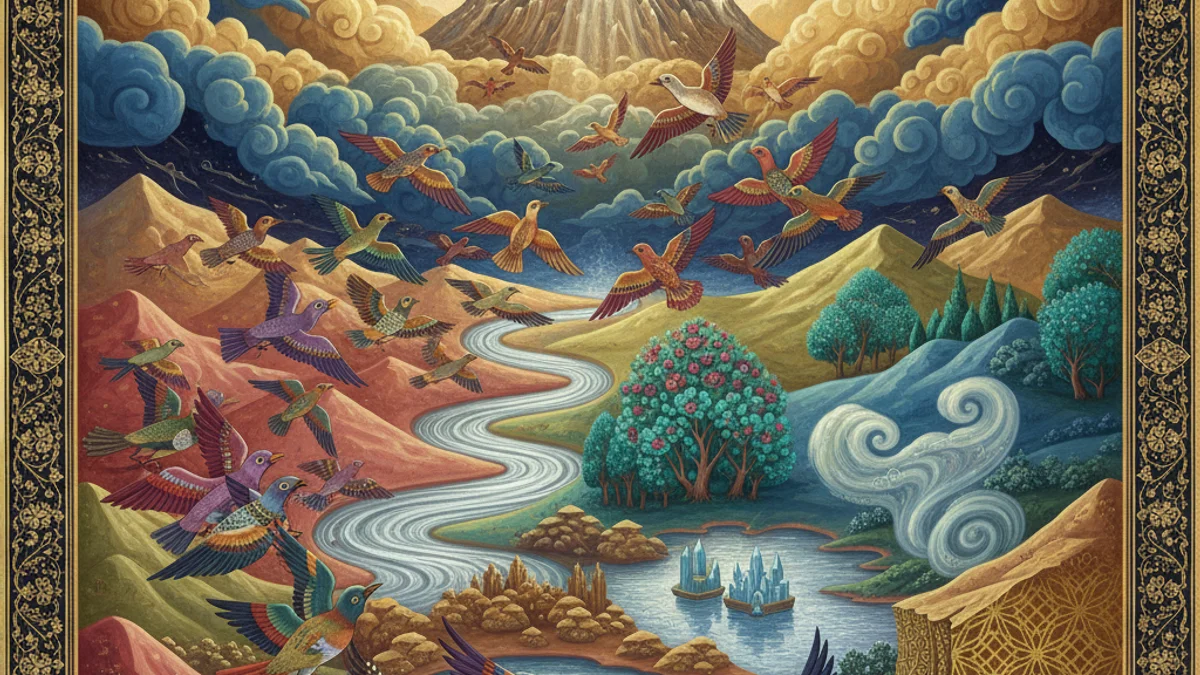
The Hoopoe, the wisest of birds, gathered all the avian species to find their true King, the Simurgh. To reach his palace on Mount Qaf, they had to cross seven perilous valleys: Quest, Love, Knowledge, Detachment, Unity, Bewilderment, and Poverty. Many birds made excuses, fearing the hardships, while others perished from exhaustion or hunger along the way. After a grueling journey, only thirty birds remained. When they finally reached the destination, they found no golden palace or physical king. Instead, they looked into a pool of water and saw their own reflections. In that moment of enlightenment, they realized that 'Si-murgh' in Persian means 'thirty birds.' The King they sought was not a separate entity, but the collective soul of those who had the courage to complete the journey. They had found the Divine within themselves.
The search for truth and the Divine is an inward journey that requires the shedding of the ego to realize one's own spiritual essence.
Questions about this story
What is the moral of Attar's Parables?
The moral is that the Divine is not found in an external location, but within the self. By conquering one's ego and enduring life's hardships, a person can achieve spiritual unity with the Creator.
Who was Attar of Nishapur?
Farid ud-Din Attar was a 12th-century Persian poet and hagiographer who significantly influenced Sufi literature. He is most famous for his masterpiece, 'The Conference of the Birds,' from which these parables originate.
What do the seven valleys represent?
The seven valleys represent the stages of the soul's spiritual progression toward enlightenment. Each valley—Quest, Love, Knowledge, Detachment, Unity, Bewilderment, and Poverty—tests a different aspect of the traveler's faith and resolve.
What does the word Simurgh mean?
In Attar's clever wordplay, 'Si' means thirty and 'murgh' means bird in Persian. This reflects the story's climax where the thirty birds realize they are the Simurgh they were searching for.
Advertisement

Good night.
