
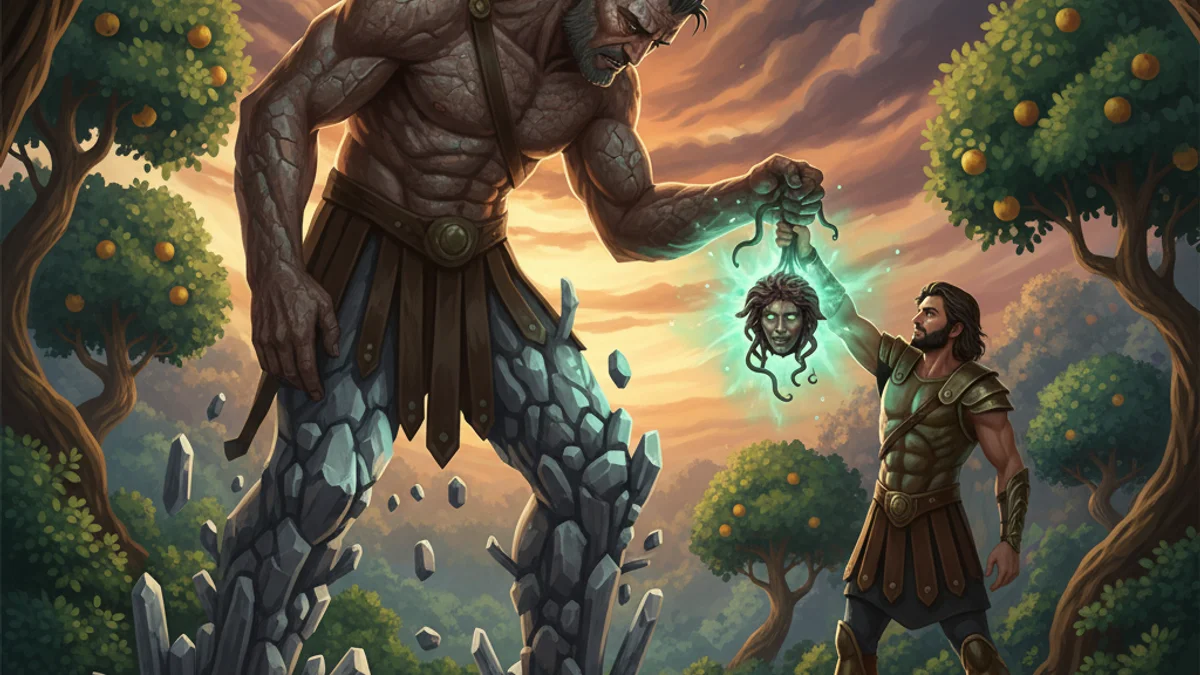
After the hero Perseus had successfully beheaded the Gorgon Medusa, he flew across the world on his winged sandals. Exhausted, he arrived at the kingdom of the Titan Atlas, who guarded the Garden of the Hesperides and held the heavens upon his massive shoulders. Seeking rest, Perseus asked for hospitality, but Atlas was wary. An ancient prophecy had warned the Titan that a son of Zeus would one day come to steal his precious golden apples. Believing Perseus to be that thief, Atlas rudely rebuffed him, threatening the hero and ordering him to leave. Insulted and unable to match the Titan's physical strength, Perseus reached into his pouch. 'Since you value your hospitality so little,' Perseus cried, 'take this gift from me!' He unveiled the petrifying gaze of Medusa. Atlas, unable to look away, was instantly transformed into cold, hard stone. His hair and beard became forests, his shoulders became cliffs, and his head reached into the clouds, forming the massive Atlas Mountains that support the sky to this day.
Rudeness and a lack of hospitality can lead to one's own downfall, and fear of a prophecy often ensures its fulfillment.
Questions about this story
What is the moral of Atlas and Perseus?
The story emphasizes the importance of hospitality and the danger of paranoia. By refusing to help a stranger due to fear, Atlas inadvertently brought about the very transformation he sought to avoid.
Why did Atlas refuse to help Perseus?
Atlas had been warned by a prophecy that a son of Zeus would steal his golden apples. Because Perseus was a son of Zeus, the Titan viewed him as a threat rather than a weary traveler.
How did Perseus turn Atlas to stone?
Perseus used the severed head of Medusa, which retained its power to turn anyone who looked at it into stone. He held the head up to Atlas when the Titan threatened him.
What mountain range was created in this myth?
The myth explains the origin of the Atlas Mountains in North Africa. It suggests that the mountains are actually the petrified remains of the Titan holding up the sky.
Advertisement
Good night.
